When a technician looks at a damaged windshield, they are running through a mental checklist in a specific order. They are not just eyeballing the crack and guessing. Five factors — worked through in sequence — determine whether a windshield qualifies for a resin repair or needs to come out entirely.
At Midtown Glass Atlanta, we go through this evaluation every day at our shop at 510 Glen Iris Dr NE and on mobile calls across Metro Atlanta. Here is the full framework so you can understand the reasoning before you call.
Factor 1: Size
The industry threshold that most insurers and shops follow:
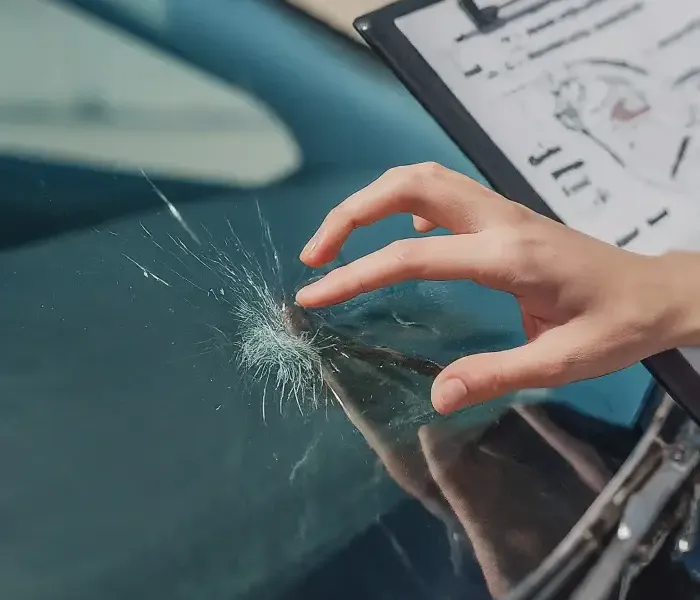
For chips (localized impact points): repairable up to roughly one inch in diameter, about the width of a quarter. Most chips smaller than a half-inch are straightforward repair candidates. Larger than a quarter and the void is too large for resin to fill uniformly.
For cracks (linear fractures): cracks under three inches repair cleanly when they are fresh and shallow. Three to six inches is a gray zone that depends heavily on the other factors below. Over six inches, a full windshield replacement is almost always the correct call.
The six-inch limit for cracks is not arbitrary. Resin injection fills the void in the outer glass layer, but longer cracks have more surface area and greater opportunity for air pockets and incomplete bonding. A poorly bonded repair fails and spreads. The goal is not just to stop the visible crack — it is to restore the structural integrity of the laminate at that location.
Factor 2: Location
Where the damage sits on the glass matters as much as its size.
Driver’s primary sight line: The roughly 12-inch zone centered on the steering wheel position is held to the strictest standard. Even a perfectly executed resin repair leaves a slight optical artifact — typically a faint shadow or change in light refraction. In the periphery, this is usually acceptable. Directly in the driver’s visual center, any distortion can be distracting at highway speeds and affect depth perception in low-light conditions. We recommend replacement for damage in the primary sight zone rather than a repair that leaves even a minor blemish.
Edge zone: The perimeter of the windshield within about two inches of the frame concentrates structural stress. The glass has less support at the frame boundary, and cracks that start at or reach the edge spread faster than cracks in the glass center. Small chips at the edge may still qualify for repair; cracks that touch the edge typically require replacement.
ADAS camera zone: Most vehicles manufactured after 2018 have a forward-facing camera mounted behind the rearview mirror that powers lane departure warning, forward collision alert, and adaptive cruise control. Any optical imperfection in that camera’s field of view — including the subtle mark left by a chip repair — can cause false sensor readings. Damage in the camera zone generally calls for replacement and camera recalibration.
Factor 3: Depth
A laminated windshield has three layers: an outer glass layer, a polyvinyl butyral (PVB) plastic interlayer, and an inner glass layer. Resin injection is an outer-layer fix.
If the damage has penetrated through the PVB interlayer and into the inner glass, repair cannot restore full structural integrity. The resin fills the outer void but cannot bridge the inner laminate gap correctly.
How to recognize deeper damage: fractures that have reached the PVB layer typically show a milky or opaque discoloration inside the break. Surface-only damage looks sharp and transparent. A technician can usually confirm depth with a small probe or by examining the break under magnification.
Factor 4: Contamination and age
Resin bonds to clean glass. When a chip or crack sits open for days or weeks, the fracture accumulates moisture, road grime, pollen, and dust. All of these interfere with adhesion and UV curing.
A chip repaired within 24 hours of impact will bond cleanly and produce a nearly invisible result. The same chip left open for two weeks may bond incompletely, leaving a more visible artifact and a weaker repair that is more likely to propagate.
Practical cutoff: fresh damage up to about seven to ten days usually remains repairable if it has not been exposed to significant moisture. Beyond that, it is a case-by-case evaluation. Atlanta’s humid summers and pollen-heavy springs make contamination a real factor — cars sitting outside here are not getting a break from the elements.
Covering fresh damage with a strip of clear packing tape preserves repairability until you can get the vehicle into service.
Factor 5: Number of breaks
One chip in a favorable location is a straightforward repair. Two chips across different areas are still likely a repair. Three or more breaks — even if each individual break is within repair size limits — raise questions about cumulative structural effect.
Multiple repairs also leave multiple resin-filled zones, and each is slightly different from the surrounding undamaged glass. Beyond two or three existing repairs on a single windshield, replacement often makes more long-term sense than adding another repair to glass that has already been compromised in several locations.
What the repair process accomplishes
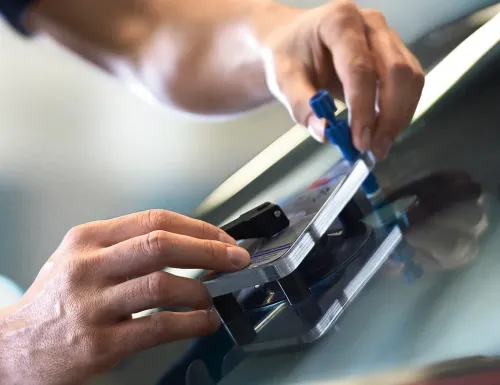
When damage meets all five criteria, resin repair works like this: the technician cleans and dries the break, positions a vacuum injector over the impact point, draws air out of the fracture, then forces UV-cure resin in under controlled pressure. The resin fills the void completely. UV light cures it hard, and the surface is polished smooth.
Drive-away time: immediate. The repair reaches full strength during the UV cure. Unlike replacement, no adhesive needs to cure after the work is done. The factory bond between glass and frame is never disturbed.
Repair restores roughly 95% of original structural strength at the damage site and stops the fracture from propagating. The repaired area will have a faint visual mark — this is expected and normal. What it will not do is spread.
What the replacement process involves
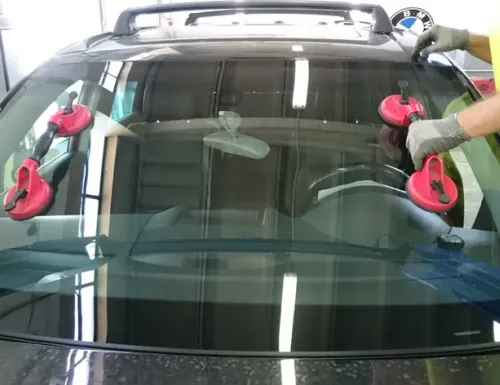
When damage exceeds repair criteria, replacement is the correct path. The technician removes trim and wipers, cuts through the existing urethane adhesive bead, lifts the old glass out using suction cups, cleans and primes the pinch weld, applies fresh urethane adhesive, and seats the new glass into position. Trim, wipers, and camera mounts are reinstalled, and any required ADAS calibration is performed before the vehicle is returned.
Safe drive-away time with modern urethane adhesives is typically 60 to 90 minutes. Temperature and humidity affect that window — cold January mornings or humid August afternoons in Atlanta can push it longer. Your technician will give you a specific time based on the adhesive used and current conditions.
At Midtown Glass Atlanta, a standard replacement runs about 90 minutes including ADAS recalibration for vehicles that require it.
How Atlanta’s climate shifts the timeline
Georgia summer heat creates a narrow window between a repairable chip and an unrepairable crack. A windshield sitting in a downtown parking lot off Peachtree Street can reach 140 to 160 degrees on the exterior surface. When you get in and cool the cabin, the temperature differential across the glass stresses any existing fracture. Spring and fall thermal cycling — cold nights, warm afternoons — pushes the same crack a bit further every day.
The takeaway: evaluate damage quickly. The difference between a $70 repair and a $350 replacement is often a matter of days.
Quick comparison
| Factor | Repair | Replacement |
|---|---|---|
| Chip size | Under 1 inch | Over 1 inch |
| Crack length | Under 6 inches (ideally under 3) | Over 6 inches |
| Location | Away from sight line and edge zone | Sight line, edge, or ADAS camera zone |
| Depth | Outer layer only | Through PVB interlayer |
| Age | Under 7 to 10 days, clean | Older or contaminated damage |
| Number of breaks | 1 to 3 | 4 or more |
| Typical cost | $60 to $120 | $250 to $600 |
| Drive-away time | Immediate | 60 to 90 minutes |
| Insurance | Often $0 deductible | Subject to comprehensive deductible |
Insurance considerations in Georgia
Most comprehensive policies in Georgia cover chip and short-crack repairs at zero deductible. Insurers actively incentivize early repair because a $70 fix prevents a $350 claim later.
Full replacement falls under your comprehensive deductible, which typically runs $250 to $500. If the replacement cost is close to your deductible, paying out of pocket rather than filing a claim may make more practical sense. See our guide on whether to file an insurance claim for windshield replacement.
Midtown Glass Atlanta works with all major carriers and handles the paperwork directly. We will verify your coverage before starting any work.
Frequently asked questions
Can a crack in the three-to-six-inch range go either way? Yes. A fresh, shallow crack at four inches that sits away from the driver’s sight line and has not reached the edge is often repairable. The same length at the windshield edge, or one that has penetrated the PVB layer, requires replacement. That middle range genuinely needs hands-on evaluation.
Will the repaired area look perfect afterward? No. Resin injection restores structural integrity and stops the crack from spreading, but the repair site looks slightly different from undamaged glass. Most people find it barely noticeable in normal conditions. In direct side lighting or bright sun, a faint mark may be visible.
How soon can I drive after a replacement? Typically one to two hours with modern urethane adhesives. For more detail on what that cure period involves and how to care for new glass, see our guide on post-replacement care.
Does Midtown Glass Atlanta handle ADAS recalibration? Yes. Every replacement on a vehicle with windshield-mounted cameras includes recalibration at our shop. No separate dealer appointment.
Ready for an evaluation? Call (404) 873-6991 or schedule online. We serve all of Metro Atlanta from our Midtown shop at 510 Glen Iris Dr NE, with same-day mobile service throughout the area.