You picked up your vehicle after windshield replacement and everything seemed fine. Two days later the adaptive cruise stopped engaging, or a warning light appeared saying “Forward Camera Unavailable,” or the lane-keeping system started nudging toward the shoulder instead of away from it. That is what uncalibrated ADAS looks like in practice.
At Midtown Glass Atlanta on Glen Iris Drive, ADAS-equipped vehicles now account for more than half of our weekly windshield replacement jobs. The questions we hear most: what exactly is calibration, do you really need it, and what happens if you skip it? Here is a straight answer to all three.
What ADAS is
ADAS stands for Advanced Driver Assistance Systems — the collection of electronics that help drivers avoid collisions, stay in lanes, and manage highway travel. The National Highway Traffic Safety Administration catalogs these systems and tracks the federal effort to standardize them across manufacturers.
Common ADAS features:
| Feature | Function |
|---|---|
| Forward collision warning | Detects vehicles and objects ahead; alerts the driver |
| Automatic emergency braking | Applies brakes independently to reduce crash severity |
| Lane departure warning | Alerts when the vehicle crosses lane markings without signaling |
| Lane keeping assist | Actively steers back toward lane center when drifting |
| Adaptive cruise control | Maintains a set following distance from the vehicle ahead |
| Traffic sign recognition | Reads speed limits and regulatory signs |
| Pedestrian and cyclist detection | Identifies people in or near the vehicle path |
| Blind spot monitoring | Warns of vehicles in adjacent lanes |
| Automatic high beams | Switches to low beams when oncoming traffic is detected |
Manufacturers brand these systems under different names: Toyota Safety Sense, Honda Sensing, Subaru EyeSight, Nissan ProPILOT, Ford Co-Pilot360, Chevy Safety Assist, BMW Active Driving Assistant, Mercedes Intelligent Drive. The underlying hardware and calibration requirements vary across brands even when the feature names sound similar.
Why windshield replacement affects ADAS
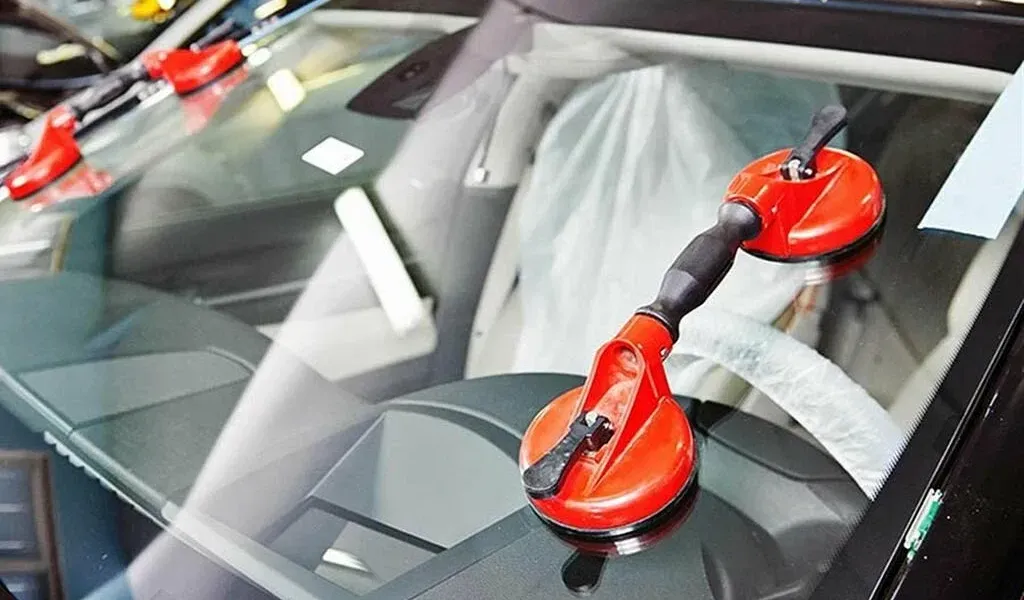
The primary ADAS camera sits behind your windshield, typically in a bracket near the base of the rearview mirror. During vehicle assembly, this camera is positioned and aimed against a known reference point with tight tolerances. The calibration data stored in the vehicle’s ADAS control module assumes the camera is pointed exactly where the factory placed it.
Windshield replacement introduces variables the stored calibration data cannot account for:
- Replacement glass, even OEM-specified, sits in a fractionally different position than the original
- The camera bracket must be transferred or remounted, which introduces small angular shifts
- A difference of half a degree in camera angle translates to several feet of position error at typical following distances
The ADAS system does not know any of this happened. It continues operating on old calibration data with a camera that is no longer pointed where that data assumed. The result is inaccurate sensor readings, erratic behavior, or silent failures the driver cannot detect until something goes wrong.
What calibration does
Calibration resets the camera’s reference frame after the windshield change. A diagnostic tool connects to the vehicle’s OBD-II port and runs the manufacturer’s calibration sequence:
- Confirms the camera has a clear optical path through the new glass
- Realigns the camera’s field of view to the vehicle’s centerline
- Updates the ADAS control module with accurate camera position data
- Tests each ADAS function to verify correct response
- Clears stored diagnostic codes related to camera misalignment
After calibration, the system has an accurate understanding of where the camera is pointing. Without it, the system does not.
Static calibration vs. dynamic calibration
This is the distinction most explanations skip. There are two calibration methods that work differently. Some vehicles need one; some need both.
Static calibration
Static calibration happens in the shop, vehicle parked.
The setup: A set of manufacturer-specific calibration targets is positioned in front of the vehicle at precise distances and heights. These are not generic charts. Toyota’s targets look nothing like Subaru’s. Ford requires different target configurations than BMW. The shop floor must be level to within approximately 0.1 degrees, ambient lighting must be controlled, and the vehicle must be at correct ride height.
The process: Diagnostic software guides the technician through the alignment sequence. The camera uses the known target positions to calculate its own orientation and update calibration data in the control module. If the initial reading falls outside acceptable range, the technician adjusts camera alignment physically and reruns until the system accepts the calibration.
Duration: 30 to 60 minutes, not counting any wait for the urethane adhesive to reach safe drive-away strength.
Which vehicles: Most vehicles with a single forward-facing windshield camera require static calibration. This covers the majority of Toyota, Honda, Hyundai, Kia, Ford, and Nissan ADAS-equipped vehicles.
Dynamic calibration
Dynamic calibration happens on the road with the vehicle in motion.
The setup: A technician drives the vehicle on a road with clearly marked lane lines and readable traffic signs. A diagnostic device connected to the OBD port monitors the calibration process. The camera uses real-world lane markings and sign positions as reference points to recalibrate itself.
Requirements: Speeds typically between 25 and 45 mph (varies by manufacturer), sustained for 10 to 30 minutes, on roads with consistent markings. Intersections, stop-and-go traffic, and roads with faded markings interrupt the calibration sequence.
Which vehicles require dynamic calibration: Subaru EyeSight is the most well-known example. EyeSight uses two cameras in a stereoptic arrangement rather than a single camera. The system calculates depth by comparing images from two slightly offset viewpoints — similar to human binocular vision. Recalibrating this system requires observing real-world depth cues in motion; a static target cannot provide that reference. Subaru’s procedure also typically includes a static pre-check before the dynamic drive.
Some Mercedes-Benz models with radar and camera combination systems, and select Volvo models with City Safety, specify a combined static-then-dynamic protocol.
Reference table:
| Make and system | Calibration type required |
|---|---|
| Toyota Safety Sense (all generations) | Static only |
| Honda Sensing | Static only |
| Subaru EyeSight (all generations) | Dynamic, typically preceded by static check |
| Mercedes Intelligent Drive (most models) | Static then dynamic |
| Nissan ProPILOT Assist | Static only |
| Volvo City Safety (2019 and newer) | Static then dynamic |
| Ford Co-Pilot360 | Static only |
| GM Safety Assist systems | Static only |
| Tesla Autopilot | Static only |
| Hyundai/Kia SmartSense | Static only |
This table is a general reference. Requirements vary by model year and trim level. We verify by VIN before quoting any job.
What skipping calibration actually causes
Active errors: Lane keeping steers toward the edge of the lane. Adaptive cruise maintains the wrong following distance. Emergency braking fires at the wrong moment or fails to fire. Traffic sign recognition shows incorrect speeds.
Silent failures: The system appears to work. No warnings on the dashboard. But the camera is reading road geometry incorrectly, and the assistance features are acting on bad data. You are trusting systems that are not performing to specification, without any indication something is wrong.
Diagnostic shutdown: Many vehicles detect calibration failure and disable ADAS functions entirely, triggering dashboard warnings. This is a safer outcome than silent failure, but it also means you drove away with non-functioning safety systems you paid to have maintained.
The ANSI/AGSC/AGRSS 002 standard published by the Auto Glass Safety Council lists recalibration as a required step in any compliant windshield replacement on ADAS-equipped vehicles. A shop that replaces your windshield without addressing calibration requirements is not following the industry standard for safe installation.
Does your vehicle need calibration?
Check near the base of your rearview mirror. If you see a small black module — with or without a visible lens — mounted to the windshield glass or headliner, your vehicle has a forward-facing camera. Calibration is required after any windshield replacement.
Quick reference by vehicle type:
| Vehicle category | Camera likely present? |
|---|---|
| Any make, 2022 or newer | Almost certainly yes |
| Any make, 2019 to 2021 | Yes on mid and upper trims |
| Any make, 2016 to 2018 | Common on higher trims |
| Pre-2016 vehicles | Uncommon outside luxury brands |
| All Tesla, Rivian, EV6, Ioniq 6 | Yes, always |
| 2020 and newer pickup trucks (Lariat/Denali/Limited trims) | Yes |
| BMW, Mercedes, Audi, Lexus 2015 and newer | Yes |
When you call us, we look up calibration requirements by VIN before quoting the job.
Calibration cost
| Calibration type | Typical range |
|---|---|
| Static calibration only | $100 to $200 |
| Dynamic calibration only | $75 to $150 |
| Static plus dynamic | $150 to $300 |
| Luxury or multi-camera vehicles | $200 to $400 |
At Midtown Glass Atlanta, calibration is included in the windshield replacement quote for ADAS-equipped vehicles. The price you hear on the phone is the price on the invoice. We perform all calibration in-house at our shop on Glen Iris Drive. You do not need a separate dealer appointment. One visit covers replacement and calibration. See our windshield replacement services and auto glass services pages for more detail.
How we handle calibration at 510 Glen Iris Dr NE
When an ADAS-equipped vehicle arrives at our shop:
- We verify calibration requirements by VIN before touching the vehicle
- Camera brackets and hardware are removed carefully during glass extraction and inspected for damage
- New glass is installed with urethane rated for the camera bracket load and vibration requirements
- We observe the required safe drive-away time before any calibration begins
- Manufacturer-specific targets are positioned to spec on our level shop floor
- Diagnostic software runs the calibration sequence until the control module confirms completion
- Each ADAS function is tested before releasing the vehicle
- You leave with written documentation of the calibration performed
For vehicles requiring dynamic calibration, our technicians drive the prescribed route and confirm completion before calling you to pick up.
Frequently asked questions
Can I drive the vehicle before getting calibration done?
The vehicle will operate, but ADAS features are either working incorrectly or disabled by the system. Either way you are not getting the safety performance the car was built with. Calibration should happen before you return to normal driving.
Do dealers charge more for calibration than independent shops?
Generally 20 to 40 percent more. The calibration procedure is identical when performed with the correct equipment and software. We use the same manufacturer-specific diagnostic tools and targets that dealers use.
My vehicle has multiple cameras. Does that mean more calibration?
Yes. Vehicles with surround-view systems, dual front cameras (Subaru EyeSight), or radar plus camera combinations may require calibrating multiple modules. We verify all calibration requirements before starting and include all of them in the quote.
Does insurance cover ADAS calibration?
Comprehensive coverage that pays for windshield replacement covers required calibration as part of a complete repair. We file the claim directly and include calibration in the documented work.
How do I know calibration was done correctly?
No ADAS warning lights on the dashboard after the service. All features (lane assist, adaptive cruise, forward collision warning) function as expected. Your installer provides written documentation of the calibration sequence performed and accepted by the vehicle.
Schedule your ADAS-equipped windshield replacement
Call now — (404) 873-6991
Midtown Glass Atlanta — 510 Glen Iris Dr NE, Atlanta GA 30308
In-house ADAS calibration for most makes and models. One visit, complete documentation, all systems verified before you leave.
Sources: NHTSA — Advanced Driver Assistance Technologies, ANSI/AGSC/AGRSS 002 Safe Installation Standard, Auto Glass Safety Council (AGSC).