Atlanta sits at the junction of I-75, I-85, and I-20 — three of the busiest freight corridors in the Southeast United States. Thousands of semi trucks pass through metro Atlanta daily, hauling everything from automotive parts to food distribution to building materials. That constant highway exposure — construction debris, tire shrapnel, sudden weather changes — puts more stress on semi truck windshields than almost any other operating environment.
A cracked windshield on an 18-wheeler is not a visibility inconvenience. It is an FMCSA violation that can park your truck at a weigh station, delay the load, and cost more in lost revenue than the replacement itself. At Midtown Glass Atlanta, we offer semi truck windshield replacement with same-day service when glass is in stock, mobile capability at truck stops and distribution yards, and documentation that covers your fleet safety files.
FMCSA compliance: what the regulations actually say
Under 49 CFR 393.60, the FMCSA sets specific standards for windshields on commercial motor vehicles. Your semi’s windshield must:
- Be free of any damage in the area swept by the windshield wipers that would obstruct the driver’s view
- Have no “starred” damage (a break with radiating cracks) greater than 3 inches in diameter
- Have no intersecting cracks (a crack that crosses another crack creates a weakened fracture zone)
- Allow full function of the defogging and defrosting systems
- Carry the required DOT AS-1 glazing certification — every windshield used in a semi truck windshield position must be AS-1 rated, meaning it is approved for any windshield location with full visibility requirements
Georgia State Patrol and FMCSA enforcement officers check windshield condition during Level I and Level II inspections at weigh stations along I-75, I-85, and I-20. A damaged windshield in the critical viewing area results in an out-of-service order. The truck stays parked until a qualified replacement is completed.
Inspection outcome table
| Damage type and location | Typical enforcement outcome |
|---|---|
| Minor chip, outside the wiper sweep area | Advisory note on inspection report |
| Chip or starred damage over 3 inches | Out-of-service order |
| Any crack through the primary viewing area | Out-of-service order |
| Intersecting cracks anywhere on the windshield | Out-of-service order |
| Repeat violations across multiple inspections | CSA Maintenance BASIC score impact, carrier review risk |
CSA score violations stay on record for 24 months. For carriers managing contracts with shippers who screen CSA scores, a windshield-related out-of-service is a meaningful operational problem.
The cost of downtime for a parked semi
A semi truck that is not moving is not earning. The financial impact of windshield-related downtime breaks down this way:
- Lost load revenue: $1,500 to $3,000 or more per day depending on the haul and freight rates
- Detention charges: Some shipper contracts penalize late deliveries; windshield replacements at weigh stations are not exempt
- Driver pay and per diem: Your driver needs to be compensated while the truck sits
- Rerouting costs: Other vehicles in the fleet or brokered loads may need to absorb the shipment
- CSA score: The out-of-service itself becomes part of your safety record for two years
A windshield replacement that gets the truck moving today instead of tomorrow saves far more than it costs. That is why same-day service is the top priority for trucking operations, not an option.
One-piece vs. two-piece windshield configurations
This is a technical distinction that matters significantly for parts sourcing and installation time.
One-piece windshields
Most current-production semi trucks use a single curved glass panel spanning the full width of the cab. One-piece windshields are urethane-bonded, similar in principle to passenger vehicles but with much larger panels and heavier adhesive requirements.
Models using one-piece configurations:
- Freightliner Cascadia (2018 and newer — the most common semi on Atlanta’s roads)
- Kenworth T680 and T880
- Peterbilt 579 and 567
- Volvo VNL (most current models)
- International LT and RH Series
- Mack Anthem
One-piece glass is typically available more quickly than split configurations and installs in a single operation. Two technicians are required for the lift and positioning.
Two-piece (split) windshields
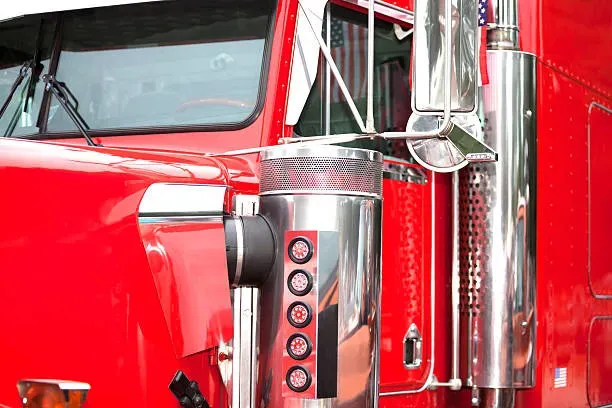
Older conventional cab designs and some current classic-style trucks use two separate flat glass panels divided by a center post (the mullion). Each panel sits in its own rubber channel gasket or adhesive bond.
Models with two-piece configurations:
- Kenworth W900 (long-haul classic)
- Peterbilt 389 (classic conventional)
- Western Star 4900 series
- Older Freightliner Columbia (2007 and earlier)
- Mack Pinnacle (older generations)
- Many pre-2010 models of most brands
Two-piece installation considerations:
Each panel must be ordered and installed separately. If only one panel is damaged, it is possible to replace a single panel — but we often recommend replacing both simultaneously when one is already damaged, because the second panel typically shows similar wear patterns and replacing both now costs less in labor than returning for the second one in a year.
The mullion strip between panels must be inspected and often replaced during glass work. A deteriorated mullion allows water intrusion and wind noise even with new glass on both sides.
Rubber channel gasket installation on older two-piece trucks requires different technique than urethane bonding. Getting the gasket seated correctly at the corners prevents leaks. This is a skill that not every shop maintains for trucks that are decades old, but we see enough W900s, Peterbilt 389s, and similar classics at our shop to keep the practice current.
Semi truck windshield specifications vs. passenger vehicles
| Specification | Semi truck | Passenger car |
|---|---|---|
| Width | 50 to 70 inches | 40 to 55 inches |
| Weight | 30 to 50 pounds or more | 15 to 25 pounds |
| Thickness | 5 to 7mm laminated | 4 to 5mm laminated |
| Configuration | One-piece or two-piece split | Almost always one-piece curved |
| Mounting | Urethane bond or rubber channel gasket | Urethane bond |
| DOT requirement | AS-1 required | AS-1 required |
| ADAS integration | Increasingly common on 2020 and newer | Standard on 2016 and newer |
Makes and models we service
- Freightliner (Cascadia, Columbia, M2 Business Class) — the highest-volume semi we service; in-stock glass for Cascadia
- Kenworth (T680, T880, W900) — one-piece and two-piece configurations
- Peterbilt (579, 567, 389) — one-piece and two-piece configurations
- Volvo (VNL, VNR) — in-stock glass for current VNL models
- International (LT Series, RH Series)
- Mack (Anthem, Pinnacle, Granite)
- Western Star (4900XD, 5700XE)
For Freightliner Cascadia and Volvo VNL, we stock one-piece glass and can typically schedule same-day. For other makes and models, we can source glass within 24 to 48 hours in most cases.
ADAS calibration on modern semi trucks
The newest generation of semi trucks from Freightliner, Volvo, and others integrates advanced safety systems that mount cameras and sensors at or near the windshield. After windshield replacement, these systems require recalibration:
Detroit Assurance (Freightliner Cascadia 2020 and newer): Forward-looking camera and radar combination system providing collision mitigation braking, lane departure warning, and adaptive cruise. Camera is mounted to the windshield and must be recalibrated after any glass change.
Volvo Active Driver Assist (Volvo VNL 2022 and newer): Emergency braking, forward collision warning, lane keeping, and distance alert. Camera-based with radar fusion. Post-windshield calibration required.
Bendix Wingman Fusion: A third-party ADAS system installed across Kenworth, Peterbilt, International, and other platforms. Combines radar and camera mounted near the windshield. Calibration procedure varies by installation configuration.
Skipping calibration on an ADAS-equipped semi leaves safety systems operating on incorrect reference data. This creates both a safety risk and a potential DOT compliance issue — if the ADAS system is specified in the vehicle’s equipment list and found non-functional during inspection, it can complicate the inspection outcome. We perform ADAS calibration in-house for commercial truck platforms.
Replacement costs
| Truck type | Typical cost range | Timeline |
|---|---|---|
| Freightliner Cascadia (one-piece, 2018 and newer) | $350 to $550 | Same-day if in stock |
| Kenworth T680 | $375 to $575 | Same-day or next-day |
| Peterbilt 579 | $400 to $600 | Same-day or next-day |
| Volvo VNL (current generation) | $350 to $550 | Same-day if in stock |
| Older two-piece configurations | $250 to $400 per panel | 1 to 2 days for sourcing on less common models |
| ADAS-equipped models (add calibration) | Add $150 to $300 | Additional 30 to 60 minutes |
Prices include glass, installation, materials, and mobile service within metro Atlanta.
Our semi truck replacement process
Step 1: Rapid assessment
Call (404) 873-6991 or text a photo of the damage. We confirm whether repair or replacement is needed, verify glass availability for your make and model, and schedule service.
Step 2: Mobile or in-shop
Mobile service is the most common choice for semi trucks. Our commercial mobile units meet trucks at:
- Truck stops and fuel stations along I-75, I-85, and I-20 in the Atlanta corridor
- Distribution centers and warehouse yards throughout the metro
- Your company’s terminal or maintenance yard
- Rest areas and large parking facilities with adequate working space
We need a level surface with enough clearance around the cab to work safely. Most truck stop lots and distribution yards work well.
In-shop service at our Midtown facility is appropriate for trucks needing ADAS static calibration with full target setup, or for fleet batches being processed together.
Step 3: Installation procedure
Our semi truck installation follows FMVSS 212 and FMVSS 208 standards:
- Protect cab interior — dashboard, seats, gauges, and telematics covered before any glass removal
- Remove exterior trim, wipers, mirror brackets, and hardware
- Extract damaged glass — cold-knife technique for urethane-bonded panels; careful gasket removal for rubber channel mounts
- Clean the frame thoroughly — remove all old adhesive, apply fresh primer to both glass and pinchweld for maximum bond strength
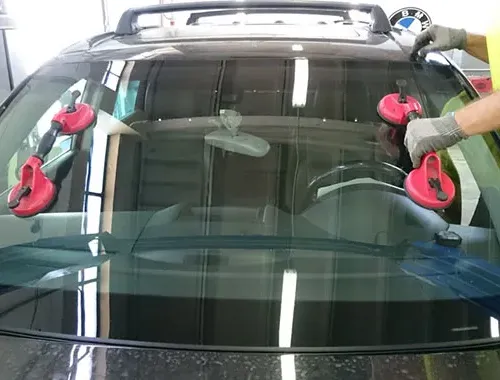
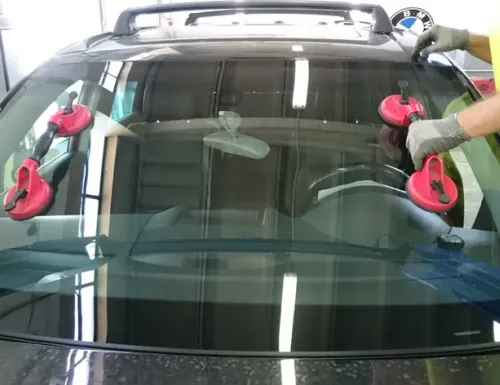
- Position new windshield — two-technician lift with commercial-rated suction equipment, precision alignment to frame
- Apply adhesive — high-modulus urethane rated for commercial vehicle loads and vibration profiles
- Cure and verify — minimum cure time observed; water test for seal integrity before vehicle returns to service
Step 4: DOT compliance documentation
We provide documentation for your fleet safety files:
- Glass specification and DOT AS-1 certification number
- Installation date and technician identification
- Adhesive type, batch number, and cure time verified
- ADAS calibration report if applicable
Preventing semi truck windshield damage
Fleet managers and drivers can extend windshield life:
- Maintain 6 or more seconds of following distance behind other large vehicles — tire debris from trucks ahead is the top source of chip damage for semis
- Reduce speed in construction zones — lower impact velocity means chips instead of cracks
- Address chips immediately — a $75 windshield repair today typically prevents a $500 replacement in four weeks
- Avoid pointing high-pressure washers directly at the windshield seal — direct pressure on the adhesive bond perimeter accelerates degradation
- Use sunshades during extended parking in Atlanta’s summer heat — thermal cycling on the cab glass is reduced significantly
Fleet and carrier programs
For trucking companies with multiple rigs in the Atlanta area:
- Priority service — Commercial vehicles go to the front of the queue; no waiting behind personal vehicles
- Volume discounts — Tiered pricing for companies with 5 or more trucks under a program agreement
- Consolidated billing — Single monthly invoice for all glass services across the fleet
- Insurance management — We file claims directly with your commercial auto insurer and handle pre-authorization
- 24/7 emergency contact — For urgent out-of-service situations, we provide after-hours scheduling for early morning service starts
- Documentation package — Full service records per vehicle, formatted for your fleet safety management system
Frequently asked questions
How long does semi truck windshield replacement take?
Most one-piece windshield replacements take 90 to 150 minutes depending on the truck model, mount type, and whether ADAS calibration is needed. Two-piece configurations may run longer. Our goal is to return your truck to service the same day.
Can you replace a semi windshield at a truck stop or rest area?
Yes. Our mobile service regularly meets trucks at locations along the I-75, I-85, and I-20 corridors. We need a level spot with enough clearance to work around the cab. Most truck stop parking areas and large rest area lots work without issue.
Do you carry Freightliner Cascadia windshields in stock?
We stock one-piece windshields for the Freightliner Cascadia (2018 and newer) and Volvo VNL — the two most common semis through Atlanta. For other makes and models, we source glass within 24 to 48 hours in most cases.
Will commercial auto insurance cover semi truck windshield replacement?
Most commercial auto comprehensive policies cover windshield damage from road debris and weather. Deductibles vary — typically $250 to $1,000 depending on your policy. We file directly with your insurer and can often get same-day pre-authorization for trucks with out-of-service status. Call us with your policy information for a quick coverage check.
What about two-piece split windshields on older trucks?
We replace one or both panels depending on the damage. For less common older models, split windshield glass may take 1 to 2 days to source. We maintain sourcing contacts for popular classic configurations including Kenworth W900 and Peterbilt 389. The mullion strip between panels is inspected and replaced if deteriorated during any split-glass service.
Semi truck windshield damage? Get back on the road today.
Call now — (404) 873-6991
Midtown Glass Atlanta — 510 Glen Iris Dr NE, Atlanta GA 30308 — Semi truck windshield specialists since 1956
At the intersection of I-75, I-85, and I-20, Atlanta is one of the country’s busiest trucking corridors. Same-day service, mobile capability, fleet pricing, and DOT-compliant documentation — one call to schedule, one visit to complete.