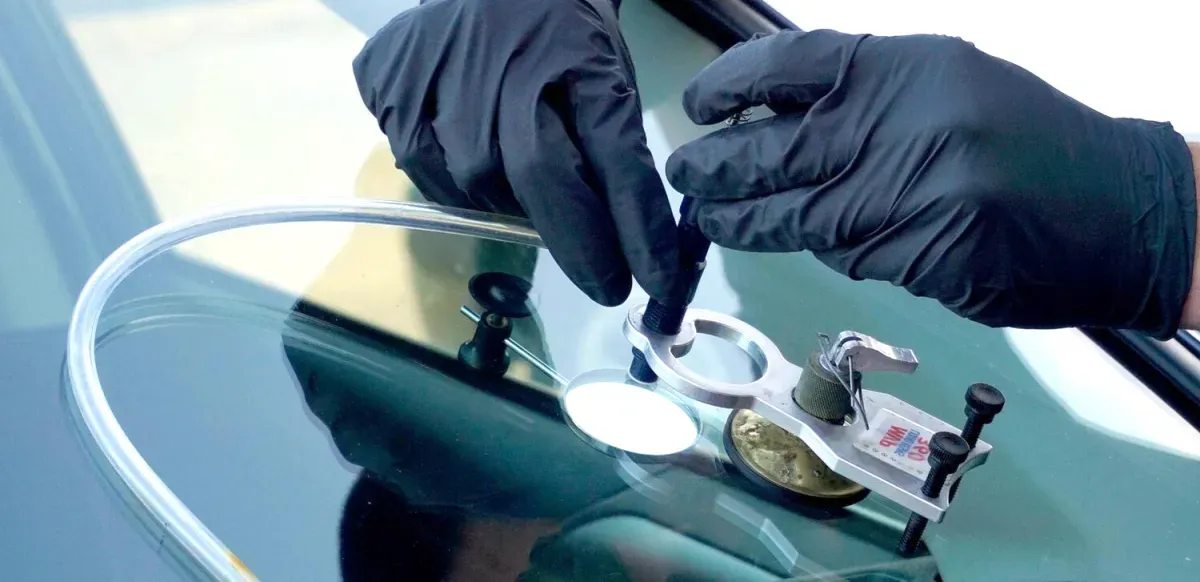
Drivers who search “windshield pitting repair” are usually hoping for a solution similar to chip repair: inject something, buff it out, done. The reality is more constrained, and understanding why will save you from spending money on a service that does not actually solve your problem.
Windshield pitting is cumulative surface erosion spread across the entire outer glass layer. There is no single impact point to fill with resin. There is no crack to stabilize. The damage exists as hundreds of thousands of microscopic craters distributed across an area measured in square feet, not square millimeters. That is a fundamentally different category of damage from a chip or crack, and it requires a different approach.
What polishing actually does and does not do
The only method that addresses pitting directly is glass polishing with cerium oxide. Cerium oxide is a fine abrasive compound used in optical glass manufacturing and finishing. When applied with a soft buffing pad rotating at controlled speed, it removes a thin, even layer from the glass surface, cutting down to a level below the shallowest pits and creating a smoother overall surface.
When conditions are right for polishing, the result is genuine: a surface that scatters light less, produces less glare from headlights and sun, and allows wiper blades to make cleaner contact. For a driver with mild pitting, polishing can feel like getting a new windshield.
The physics limit kicks in with moderate and severe pitting. Here is the problem: you cannot remove unlimited material from a curved optical surface and maintain its clarity. Glass polishing creates a slight flattening effect in the polished zone. On a surface with mild, shallow pits, the amount of material removal needed to reach below the craters is small enough that the optical effect of the removal itself is negligible. On a surface with deep, dense pitting, reaching below the craters requires removing enough material to create measurable distortion in the glass. You end up with a windshield that has reduced glare in direct sunlight but new distortion in the driver’s field of view.
This is why experienced technicians are conservative about recommending polishing. Pushed past mild pitting, it trades one visibility problem for a different one.
The three severity categories
Mild pitting: Surface craters are shallow, roughly 10 to 15 microns deep, and not densely packed across the driver’s primary field of view. The windshield looks clear in most conditions, with noticeable glare only in direct low-angle sun. Polishing produces a meaningful, lasting improvement. Expect results to last 1 to 2 years before the surface returns to the same state through continued exposure.
Moderate pitting: Craters are deeper and more densely packed. The haze is visible in flat light if you look at the glass from an angle. Night driving shows consistent starburst patterns around headlights that overlap and reduce contrast. Polishing produces partial improvement. Flat-light clarity often improves noticeably, but glare in challenging conditions may remain. Many drivers find this an acceptable tradeoff for extending the windshield’s life by another year; others find the partial result unsatisfying. Honest technicians explain what to expect before you commit.
Severe pitting: Craters are deep and cover the driver’s primary field of view densely. The haze is visible in normal lighting. Night driving on I-285 or the Downtown Connector is uncomfortable, and sunrise/sunset commutes create whiteout zones that require slowing down. Polishing does not solve severe pitting. The material removal needed would create distortion that is worse than the original problem. Windshield replacement is the only effective option.
Why Atlanta highways produce severe pitting
The geometry of Atlanta’s road network puts drivers in more concentrated debris exposure than in many comparable metro areas.
The I-285 perimeter, specifically the segments between I-20 and I-75 on the south and west sides and the I-285/I-85 interchange at Camp Creek, has been under active construction for years. Construction exposes base aggregate, creates surface irregularities, and concentrates heavy equipment and dump truck traffic. Drivers at standard highway following distances are in the debris field continuously.
The I-75 and I-85 corridor through the Downtown Connector concentrates commercial traffic at the highest density of any highway segment in the metro. Six lanes of traffic at 60 to 70 mph, with significant truck volume, generates a debris environment more intense than the average urban highway.
Trucks hauling aggregate from quarries in Cherokee, Forsyth, and Pickens counties travel the I-75 corridor to serve metro construction sites daily. Even tarped loads lose fine material around cab openings and tarp edges. Vehicles following at standard distances receive debris continuously. Moving to the far-left lane when these trucks are ahead is one of the most effective things an Atlanta driver can do to extend windshield life.
Georgia’s pollen season adds a spring abrasive cycle. Pine pollen granules that accumulate on the glass surface get dragged across it by wiper blades repeatedly during March and April. Individual pollen grains are too soft to scratch glass, but dense, dry pollen acted on by wiper blades contributes to micro-abrasion over multiple seasons.
What replacement actually provides that polishing cannot
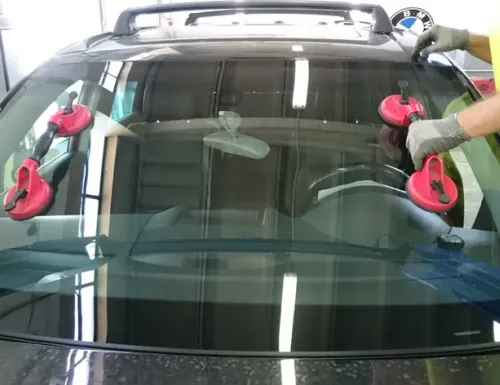
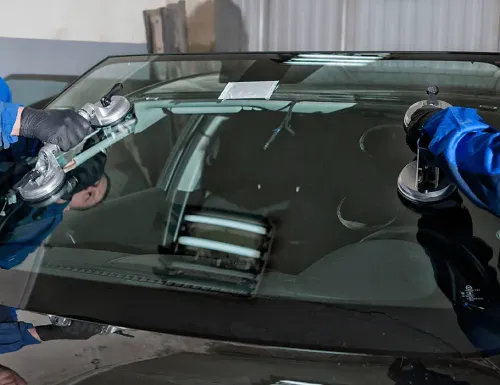
A new windshield gives you the optical clarity the glass had when it left the factory. The outer surface is smooth at the microscopic level. Light passes through it in straight lines rather than scattering. The driver can see at night and in low sun conditions without the glare that pitting creates.
For vehicles with ADAS cameras, forward-facing sensors for lane keep assist, adaptive cruise control, and forward collision warning use the windshield as part of their optical path. A heavily pitted windshield degrades those systems’ performance. Replacement restores camera accuracy. Calibration of the ADAS camera is required after windshield replacement on vehicles that have it, and we perform that calibration at our 510 Glen Iris Dr NE shop.
The safety case for replacing a severely pitted windshield is not abstract. Sunrise and sunset are statistically the most hazardous driving periods of the day because low sun angle creates visibility challenges for all drivers. A pitted windshield amplifies that hazard. Pedestrian visibility, lane line contrast, and sign legibility all degrade in conditions that a severely pitted windshield makes worse.
Cost comparison at Midtown Glass Atlanta
| Service | Typical cost | Time required |
|---|---|---|
| Professional polishing (mild pitting) | $75 to $150 | 60 to 90 minutes |
| Full replacement, standard vehicle | $200 to $400 | 90 to 120 minutes |
| Full replacement with ADAS calibration | $300 to $600 | 2 to 3 hours |
Most comprehensive auto insurance policies cover windshield replacement when pitting has reached a level affecting driving safety. We handle insurance claims directly. Call us before your appointment and we will check your coverage and tell you your actual out-of-pocket cost before you commit.
Read more about windshield insurance claims.
Slowing down pitting on a new or recently replaced windshield
All windshields develop pitting over time on Atlanta highways. The rate is within your control.
Maintain 4 or more seconds of following distance behind any truck, especially dump trucks, flatbeds, and concrete mixers. Debris impact rate drops off rapidly with distance. Moving from 2-second to 4-second following distance behind a gravel truck on I-285 reduces the concentration of particles reaching your windshield substantially.
Apply a hydrophobic glass sealant twice a year. These coatings do not stop pitting but create a sacrificial surface layer that takes abrasion before the glass does. When the coating wears away, it can be reapplied. The glass underneath is preserved for longer.
Replace wiper blades every 6 to 12 months. Worn blades collect debris in the contact edge and drag it across the glass on every pass. New blades sweep cleanly and do not contribute to surface wear.
Always spray washer fluid before running wipers on a dry, dusty windshield. Fluid floats grit up off the surface so the wiper sweeps liquid rather than grinding particles in.
Our assessment process
We do not recommend polishing or replacement without seeing the windshield first. At Midtown Glass Atlanta’s 510 Glen Iris Dr NE shop, we evaluate pitting severity under proper magnification and lighting. We look at:
- The driver’s primary field of view zone, where optical quality matters most
- The full wiper sweep area, where pitting affects wiper performance
- The perimeter edges, where deep pitting can contribute to thermal crack vulnerability
If polishing is a genuine option for your windshield, we will tell you so and explain what improvement you can realistically expect. If the pitting has gone past where polishing is effective, we will tell you that too and explain why. We have no interest in selling a polishing service that will not solve the problem.
Assessments are free. Call us or stop by 510 Glen Iris Dr NE.
Frequently asked questions
My heads-up display is distorted. Is that from pitting?
Yes. The heads-up display projection zone on your windshield is a treated section of glass designed to reflect the projected image. Pitting in that zone scatters the projected image. Polishing that specific zone may help if pitting is mild. If pitting is severe, replacement with the correct OEM-spec glass that has the HUD treatment in the right location is needed. We verify glass specifications before ordering.
Is there a filler I can apply to the pits myself?
No product available to consumers fills pits at the microscopic level in a durable way. The glass surface is curved, exposed to large temperature swings, UV, wiper friction, and repeated impacts. Any filler compound applied to the exterior would degrade quickly and would not maintain optical clarity even initially. There is no DIY fix for windshield pitting.
How do I know if my ADAS system is degraded by pitting?
Signs include the adaptive cruise control or lane-keep assist behaving inconsistently when conditions have not changed, or the forward collision warning activating in situations where it did not before. These can have mechanical causes as well, but if pitting is severe and the behaviors correlate, the camera optical path through the windshield is a reasonable suspect.
Can I get a same-day replacement at Midtown Glass Atlanta?
For most standard passenger vehicles, yes. We stock glass for the most common vehicles in the Atlanta market. Specialty vehicles, older models, and vehicles with specific acoustic or tinted glass options may require an order. Call (404) 873-6991 to confirm availability for your vehicle before scheduling.
Midtown Glass Atlanta, 510 Glen Iris Dr NE, Atlanta, GA 30308 | (404) 873-6991 | sales@glassinc.net
Free pitting assessments. Same-day service on most vehicles. Honest recommendations. Contact us or get a replacement quote. Serving Atlanta drivers since Glass Inc opened in 1956.