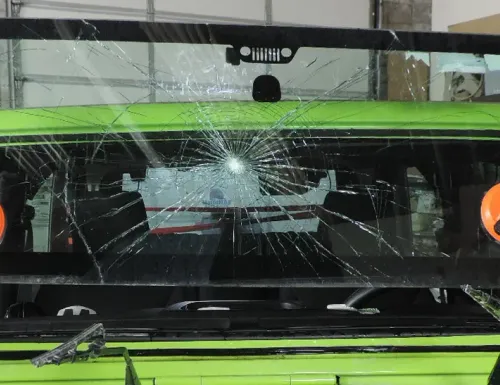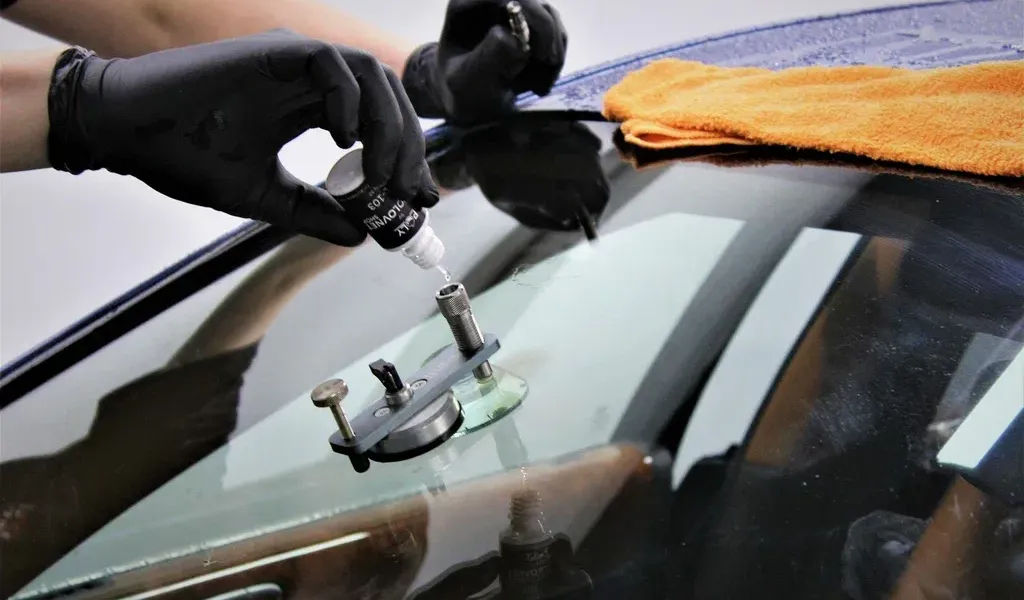
Most windshield damage starts as a chip. That small impact point — a pebble kicked up by the dump truck ahead of you on I-285, a piece of aggregate near a Midtown construction zone — leaves a specific mark in the outer glass layer. What that mark looks like shapes everything about whether it can be repaired or whether you eventually need a full windshield.
Chips and cracks behave differently, and the distinction matters. A chip is localized: a discrete void in the glass surface created by a direct impact. A crack is linear: fracture that has traveled. Most chips can be fixed with resin injection in 20 minutes. Some cannot. Knowing which kind you have — and what condition it is in — is the actual question.
The six chip types
Bullseye
A clean circular divot with a cone-shaped void going into the glass and a dark center point at the contact spot. Bullseyes are the most common chip type and the easiest to repair because the shape is symmetric, the void is well-defined, and resin flows into it evenly. Bullseyes up to about one inch in diameter almost always qualify for repair.
Half-moon
Like a bullseye but semi-circular, with a straight edge where the debris struck the glass at an angle rather than straight on. Repair outcomes are similar to bullseyes. Under one inch from flat edge to curved perimeter, half-moons are good repair candidates.
Star break
An impact point with two to six short cracks radiating outward, like spokes from a hub. Small star breaks under an inch across are ideal — the cracks are short enough that resin fills all of them cleanly. Star breaks between one and three inches across can still repair well, though the result is slightly more visible. Beyond three inches total span, resin injection becomes less reliable because the radiating cracks create more surface area for air to get trapped.
Combination break
A bullseye or half-moon center with star-pattern cracks radiating from it. This is the most complex chip type because it combines a void with traveling fractures. Small combination breaks under two inches total are often repairable. Larger ones depend on whether any of the radiating cracks have started traveling beyond the chip zone. If a crack has separated from the star pattern and started moving on its own, the window for repair narrows fast.
Pit
A very small, shallow surface divot with no visible crack patterns. Pits result from tiny debris — sand, grit, fine road particles — hitting the glass at speed. Individual pits are usually repairable, though the result leaves a small mark because the void is too shallow for the resin to form a strong anchor. Accumulated pits across a large area are a different issue covered below.
Floater chip
Not a shape description but a location one. A floater is any chip that sits in the open glass field, away from the windshield edges and outside the driver’s immediate sight zone. Location matters because structural stress is lowest in the center of the glass, making floaters the most forgiving chip type regardless of shape.
Why resin injection works — and where its limits are
When something strikes a windshield, it creates a void in the outer glass layer filled with air. Air has no structural resistance; the fracture continues to propagate because nothing is holding it in place. Resin replaces the air.
The technician places a vacuum injector over the impact point, draws air out of the fracture, then forces UV-cure resin in under controlled pressure. The resin fills every void in the break, bonds to the surrounding glass, and is cured solid under UV light. With the void filled, the fracture has nowhere to travel. Structural integrity is restored to roughly 95% of the original glass at that location.
What resin cannot fix:
- Damage that has penetrated through the inner plastic interlayer (PVB) into the inner glass layer. Resin is an outer-surface solution only.
- Breaks contaminated with moisture, oil, or debris. Contaminants prevent resin from bonding cleanly.
- Edge damage where structural stress will keep pushing cracks regardless of the fill.
- Damage that is visually invisible after repair. The cured resin and surrounding glass have different optical properties — the repair site will look better than the original break, but it will not look like undamaged glass.
The contamination problem
This is the factor most Atlanta drivers underestimate. A chip that impacts on a dry morning and gets repaired that same afternoon will produce excellent results — clean bond, minimal visibility, maximum durability. The same chip left open through a week of Atlanta summer humidity, pollen, and afternoon rain showers is a much harder repair.
Moisture inside a chip break is the main problem. When water gets into the void, it sits in the crack and prevents resin from bonding to the glass surface. UV curing is also affected because moisture scatters the light needed to harden the resin. The result is a repair that looks incomplete and may not hold as long.
What to do while you wait for service:
- Cover the chip with clear packing tape. This blocks moisture and road debris without obstructing visibility.
- Avoid car washes until the chip is repaired. High-pressure water and soap force contaminants into the break.
- Park in shade when you can. Heat causes the glass to flex and the chip to breathe in moisture.
Get chips evaluated within 24 to 48 hours of the impact when possible. In Atlanta’s summer, that window is meaningful: thermal cycling from the morning heat and afternoon air conditioning is constant.
Location thresholds specific to chips
Driver’s sight line
Even a small chip in the center of your visual field is a borderline call. The repair will leave some visible artifact — usually a faint mark or slight change in refraction — and that artifact is more acceptable in peripheral vision than directly ahead of the driver. We assess these honestly: if the repair result would be genuinely distracting in your primary sight zone, we recommend replacement for the clearer result.
ADAS camera zone
The area near the top center of the windshield, behind the rearview mirror, houses the forward-facing camera on most 2018 and newer vehicles. Lane departure warning, automatic emergency braking, and adaptive cruise all depend on optical clarity through that zone. Chip repairs there are evaluated case by case. If the repaired area would fall within the camera’s field of view, replacement and recalibration is the correct path.
Edge zone (within two inches of the frame)
Edge chips are more likely to develop cracks after repair because the frame concentrates structural stress at the perimeter. A small bullseye at the edge may technically be repairable, but we watch edge-adjacent repairs closely and are more conservative about recommending them. Cracks that start at or have already reached the edge require replacement.
Cost and timing
A single chip repair at Midtown Glass Atlanta runs $50 to $75 and takes 15 to 20 minutes. You drive away immediately — no adhesive cure wait, no same-day restrictions. Multiple chips (two or three) typically run $75 to $100 and take 25 to 30 minutes.
Replacement starts around $200 for basic vehicles and runs $400 to $600 or more on late-model vehicles with ADAS cameras, acoustic glass, or heated glass elements. Service takes 90 to 120 minutes with a one-hour drive-away wait after installation.
Most comprehensive auto insurance policies in Georgia cover chip repairs at zero deductible. Details on using insurance for glass service.
Frequently asked questions
How large a chip can actually be repaired? Up to approximately one inch in diameter, about the size of a quarter. Beyond that, the void is too large for resin to fill with uniform pressure and a clean result. The repair becomes incomplete and is more likely to fail.
Can I use a store-bought kit? Hardware and auto parts stores sell repair kits for $10 to $20. The vacuum systems are weaker than professional equipment, the resin quality is lower, and the UV cure process is less controlled. A $50 to $75 professional repair holds better, looks better, and comes with a warranty. DIY results are variable and often disappointing.
What if the chip has a crack starting from it? A chip with a crack traveling from one of its points is now a combination damage situation. Repairability depends on the length of that crack. Under three inches from the chip edge, still often repairable. Over six inches, replacement is almost certainly the answer. Do not wait to find out which direction it is heading.
Does insurance cover chip repairs? Most comprehensive policies cover chip repairs at zero deductible. Call (404) 873-6991 and we will verify your coverage and file the claim on your behalf.
Bring your chipped windshield to Midtown Glass Atlanta at 510 Glen Iris Dr NE, or send us a photo for a fast assessment. We have been evaluating windshield damage since 1956 and will tell you directly whether yours qualifies for repair or needs replacement.