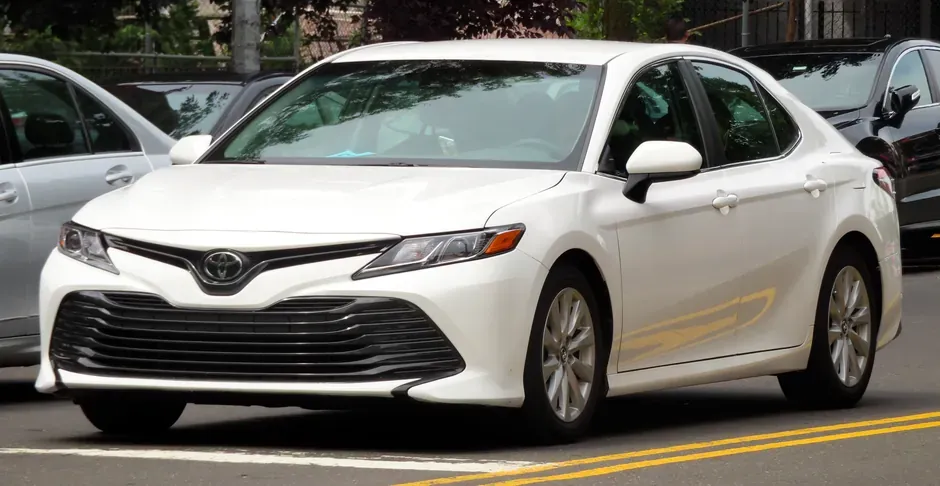
The Toyota Camry has topped US midsize sedan sales for decades. In Atlanta, it shows up on every highway and in every office parking deck. That kind of prevalence is good news for your windshield: Camry glass is manufactured in volume, OEM-equivalent parts are widely available, and shops that know the model well can handle same-day service for most trims.
The main thing that changed with the 2018 Camry was Toyota Safety Sense becoming standard across all trims. That is the system that places a forward-facing camera on your windshield, near the top center, integrated into the housing next to the rearview mirror. Pre-Collision System with pedestrian detection, Lane Departure Alert, Lane Tracing Assist, Automatic High Beam control, and Radar Cruise Control all depend on this camera being correctly positioned. The millimeter-wave radar for the collision and cruise system sits in the front bumper grille, completely separate from the windshield. After windshield replacement, the radar stays aligned. The windshield camera does not.
Toyota uses static calibration to reset the camera. The vehicle goes on a flat, level surface. A specific Toyota target board is set at a precisely measured distance from the front of the car, perpendicular to the vehicle’s center axis. The technician runs the alignment sequence through Toyota’s diagnostic system. It takes 20 to 30 minutes when the setup is correct. Done on a sloped floor or with an approximated target distance, the camera will be miscalibrated and the lane departure warnings or pre-collision alerts may not behave as expected.
At Midtown Glass Atlanta, we perform Toyota Safety Sense calibration in-house at 510 Glen Iris Dr NE. We have been in the auto glass business since 1956 under the Glass Inc name. Our AGSC-certified technicians handle Camry replacements regularly and have a dedicated calibration area with a level floor and fixed target positioning.
HUD glass and acoustic glass by Camry trim
Two Camry-specific glass differences are worth knowing before you schedule:
Heads-up display glass: Some Camry XSE and XSE V6 trims, along with certain XLE and Nightshade editions depending on model year, offer an available heads-up display that projects speed and navigation data onto the windshield. HUD glass has a specific optical coating that controls how the reflection appears to the driver. Installing standard laminate on a HUD-equipped Camry produces double-imaging: the projected image splits into two overlapping reflections at different focal distances. We stock OEE HUD-compatible glass for the trims and years that need it. If your Camry has a HUD, tell us your exact year and trim when you call so we pull the right part.
Acoustic glass: XLE and XSE trims use acoustic laminated glass as standard from the 2018 Camry onward. The acoustic interlayer absorbs sound energy between the two panes. On I-285 or GA-400 at speed, an XLE or XSE Camry with acoustic glass runs quieter than a base LE in the same lane. Replacing that glass with standard laminate changes the highway experience in a way most XLE and XSE owners notice. We use OEE acoustic glass for these trims, not generic laminate.
LE and SE trims use standard laminated glass. These are among the highest-volume Camry replacement jobs in Atlanta, which keeps parts costs lower and same-day scheduling easy.
Repair vs. replace for the Camry
Resin repair works on chips smaller than a quarter that fall outside the Toyota Safety Sense camera zone and outside the driver’s direct forward view. The camera zone is the area immediately surrounding the rearview mirror mount, roughly six to eight inches wide at the top center of the glass. Outside that zone, resin injection takes 25 to 30 minutes: the technician cleans the impact point, draws out trapped air with a vacuum tool, fills the void with optical resin, and cures it under UV light. The chip leaves a faint shadow but stops spreading. No calibration is needed after a repair.
Replace the glass when the crack runs longer than six inches, when any part of the damage is within the camera zone, when the crack starts at the glass edge (threatening the perimeter seal), or when the distortion falls in the driver’s line of sight. For HUD-equipped Camrys, there is less tolerance for damage or repairs near the projection zone because even a repaired chip can scatter the display reflection.
One Atlanta-specific note: a Camry parked outdoors on a hot summer afternoon can see its windshield surface temperature climb well above 140 degrees. A chip that would spread slowly in spring can run three to four inches in a week during August heat. Getting chips looked at quickly, even if the answer turns out to be a simple repair, saves money.
What the job looks like in practice
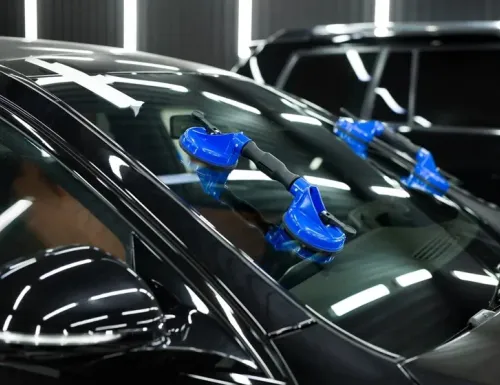
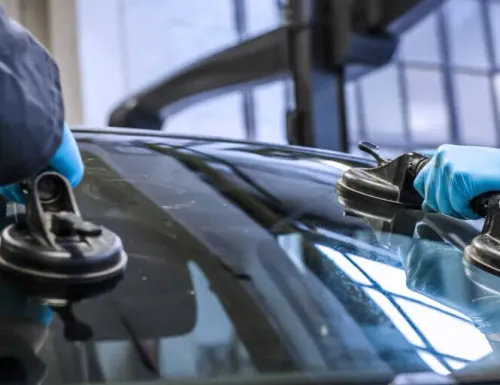
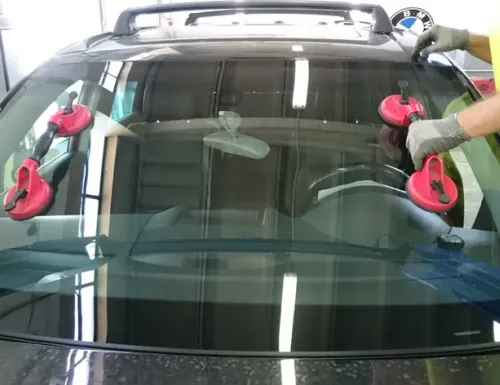
Trim removal starts at the mirror bracket and A-pillar covers. The old glass comes out via cold knife, preserving the pinch weld channel. A fresh urethane bead goes down, the new glass gets set and pressed into the lower channel first, then aligned across the full opening. Trim reinstallation, sensor bracket transfer, and a check of the rain sensor follow. Then the car moves to calibration.
Glass installation takes 60 to 90 minutes. Toyota Safety Sense calibration adds 20 to 30 minutes. Safe drive-away adhesive cure is 30 to 45 minutes. For a fully equipped Camry with TSS calibration, plan for two to two and a half hours from arrival to keys.
Mobile service is available for the glass installation at your home, office, or parking lot. Toyota Safety Sense calibration requires the shop’s level calibration area. Many customers schedule mobile installation and same-day in-shop calibration back to back, completing both before midday.
Service area, pricing, and insurance
We serve the full Atlanta metro from 510 Glen Iris Dr NE: Alpharetta, Marietta, Duluth, Roswell, Sandy Springs, Johns Creek, Smyrna, Woodstock, Lawrenceville, Cumming, and Buford.
Call (404) 873-6991 or email sales@glassinc.net to schedule. The instant quote tool gives an estimate based on your year, trim, and options. Our prices page shows general cost ranges by vehicle type. Georgia comprehensive auto insurance typically covers windshield replacement and we file all claim paperwork with your carrier.
Frequently asked questions
How much does Toyota Camry windshield replacement cost in Atlanta?
An LE or SE Camry with standard glass and Toyota Safety Sense calibration typically runs $350 to $475 all-in. XLE and XSE trims with acoustic glass or HUD (where applicable) are usually $475 to $600. Camrys from before 2018 without Toyota Safety Sense land in the $250 to $375 range. Call (404) 873-6991 or use the instant quote tool for specifics on your year and trim.
Does Toyota Safety Sense require recalibration after windshield replacement?
Yes, on all 2018 and newer Camrys. The forward-facing camera is aligned to the windshield glass. Replace the glass and the alignment resets. We include static camera calibration in every replacement for TSS-equipped Camrys and do it in-house.
Does my Camry’s front radar need recalibration after windshield replacement?
No. The millimeter-wave radar module lives in the front bumper grille, not on the windshield. It does not need recalibration after windshield work. Only the windshield-mounted camera requires the static calibration procedure.
How do I know if my Camry has acoustic glass?
If your Camry is an XLE or XSE trim from 2018 onward, it has acoustic laminated glass. LE and SE do not. For a pre-2018 Camry or a special edition trim, call us at (404) 873-6991 with your year and trim and we can confirm.
How long does Camry windshield replacement take?
Glass installation runs 60 to 90 minutes. Toyota Safety Sense calibration adds 20 to 30 minutes. Adhesive cure time is 30 to 45 minutes. Total for a TSS-equipped Camry: about two to two and a half hours.
Is OEE glass okay for a Camry, or should I insist on OEM?
OEE glass from a reputable manufacturer meets the same DOT optical and safety standards as factory-supplied glass. For LE and SE trims, OEE is the right and most cost-effective choice. For XLE and XSE with acoustic glass, we specify OEE acoustic laminate. For HUD-equipped trims, we use OEE glass that meets the HUD reflection specifications. We do not install glass from unrated suppliers.