BMW’s Driving Assistant and Driving Assistant Plus packages both rely on a forward-facing camera positioned at the top of the windshield, near the rearview mirror mount. On the 3 Series and many 5 Series configurations, this is a single-lens unit. On larger or better-equipped models, the X5, 7 Series, and recent 3 Series variants with Driving Assistant Plus, BMW adds short-range radar and sometimes a stereo camera layout to support the expanded feature set. All of it depends on the windshield being optically correct and mechanically stable in the frame.
Windshield replacement on any BMW with driver assistance features requires camera recalibration. That recalibration starts with a static procedure: the vehicle parks on a level surface, a calibration target board sits at a specified distance and height in front of the camera, and the software re-establishes the camera’s reference points. On many recent BMWs, a dynamic phase follows, requiring a drive at specific speeds to complete the learning sequence. Skip either step and the car may appear fine while lane assist behaves unpredictably or collision warnings fire late.
Midtown Glass Atlanta at 510 Glen Iris Dr NE handles both phases of calibration in-house as part of every BMW replacement. No separate dealer visit needed.
IR glass, acoustic glass, and why the spec matters
BMW introduced infrared-reflective (IR) glass across much of its lineup. The IR coating is embedded within the glass laminate and reflects solar heat before it enters the cabin, reducing interior temperature without the air conditioning system working as hard. On an Atlanta July afternoon when a parked car can reach 140 degrees inside, IR glass is a meaningful difference.
IR-rated BMW glass cannot simply be swapped for standard clear glass. The coating changes the solar energy transmittance values. A non-IR replacement physically fits the car, but the cabin runs noticeably hotter and the climate system compensates with increased fan load. For X5 and 7 Series owners who park in exposed lots near Lenox Square or at Perimeter Center, this shows up every single day.
Acoustic glass is a separate feature, also present on many BMW models. The PVB acoustic interlayer reduces wind and tire noise, contributing to the cabin refinement BMW buyers expect. Budget aftermarket glass skips this layer. The wind rush that starts appearing around 65 mph on I-285 after a budget replacement is not coincidence. It is the missing interlayer.
The HUD complication
Heads-up displays are available on the G20 3 Series, G30 and G60 5 Series, 7 Series, X5, iX, and other models. A HUD-equipped BMW uses a windshield with a wedge angle built into the glass to prevent a double image of the projected speed and navigation data. The two glass surfaces are not perfectly parallel; the wedge is calculated to cancel the reflection.
If a shop installs a non-HUD windshield in a HUD-equipped BMW, the display becomes unusable. The driver sees a primary image and a ghost image offset by several centimeters. This is not fixable by software adjustment. The wrong glass has to come out. We verify HUD compatibility from the VIN before ordering glass. Use our instant quote or call (404) 873-6991.
The 3 Series on Atlanta roads
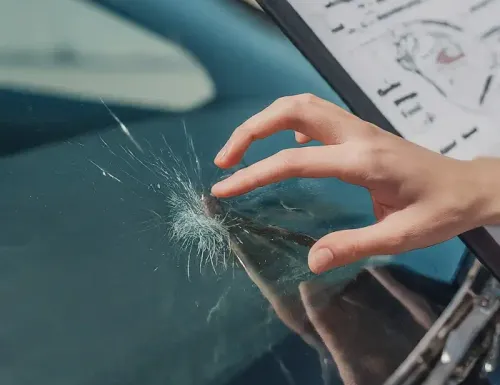
The 3 Series is the most common BMW in Atlanta and one of the cars we see most frequently for windshield service. Its profile sits relatively low to the road and it is a daily driver on I-285 and GA-400, both of which have active construction zones generating consistent debris. A stone chip on a G20 3 Series often lands directly in the camera zone, making repair impractical. The camera housing brackets to the windshield interior, and chips within a few inches of the mount interfere with the calibration surface.
M models add another consideration: some M Performance and full M cars have carbon fiber trim around the A-pillar that requires extra care during removal and reinstallation. Damage to carbon fiber trim during a rushed removal is expensive to address. We use the correct trim tools for these models.
In-shop vs. mobile for BMWs
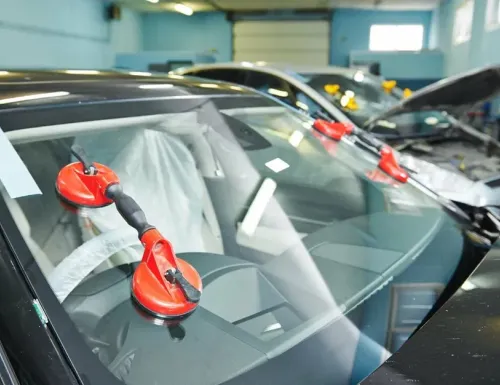
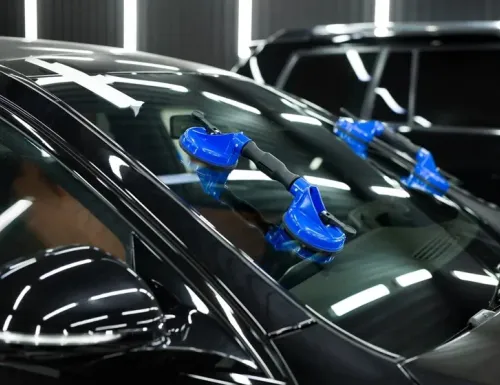
Most BMW replacements, particularly those with Driving Assistant cameras, should be done at our Midtown facility rather than in a parking lot. The calibration target procedure requires a flat, level, clean floor with controlled lighting and a measured distance between the vehicle and the target. Our shop meets all of those requirements. Mobile installation is possible for BMWs without cameras or for repair-only work, but for any car with Driving Assistant, in-shop is the more reliable path.
What to expect in the appointment
A full BMW windshield replacement with static ADAS calibration takes 100 to 160 minutes. Models requiring dynamic calibration (a subsequent highway pass) add 20 to 30 minutes. We provide a written quote covering glass, mounting hardware, adhesive, and calibration before any work starts.
Chip repair on a BMW runs 25 to 40 minutes. We assess the chip size, depth, and location. Chips under an inch that fall outside the camera zone and the driver’s direct line of sight are good repair candidates. Chips at the glass edge, in the camera zone, or in a crack pattern are not.
Insurance covers windshield replacement under comprehensive policies, and we work directly with all major carriers and file the claim on your behalf. Glass claims generally do not affect your premium.
For a model-specific price, call (404) 873-6991 or get a quote at /instant-quote/. Our shop has operated in Atlanta since 1956 and holds AGSC certification. Reach us at sales@glassinc.net.
Frequently asked questions
What BMW models need static AND dynamic calibration after windshield replacement?
Any BMW with Driving Assistant Plus, which includes active lane keeping, evasive steer assist, and extended traffic jam assist, requires both static and dynamic calibration. Standard Driving Assistant typically requires static only. Two vehicles of the same model year and series can differ based on their option packages, so we confirm from the build data before the appointment.
How much does BMW windshield replacement cost in Atlanta?
Expect $500 to $1,100 depending on model, year, glass type (IR vs. standard, HUD vs. non-HUD), and calibration scope. 7 Series and X7 models with HUD and full Driving Assistant Plus are at the high end. A base 3 Series without HUD and with standard Driving Assistant is considerably lower. We quote all-in with no hidden fees.
Can you source genuine BMW glass?
Yes, for most models we can source glass from BMW-approved manufacturers (typically AGC, Pilkington, or Saint-Gobain). If original equipment glass is preferred and available within a reasonable lead time for your model, we can order it. For most replacements, high-quality OEM-equivalent glass from those same manufacturers performs identically.
How soon can I drive after BMW windshield replacement?
Safe drive-away time is approximately 60 minutes after installation using high-strength urethane adhesive. We give you the exact time based on the adhesive batch and ambient temperature conditions that day.
Will a BMW windshield replacement affect my heads-up display?
Not if the correct glass is installed. We verify HUD compatibility from the VIN before ordering. If you had a prior replacement elsewhere and the HUD image looks doubled or blurry, bring the car in. The wrong glass is the likely cause.
See our windshield replacement, windshield repair, and ADAS calibration services.