Atlanta has well over 40 auto glass shops competing for windshield jobs. National chains like Safelite coexist with dozens of independent shops, mobile-only operators, and dealership service departments. They all show up in search results and they all say largely the same things about quality and pricing.
The differences between a good installation and a poor one are not visible at the time of service. They show up three weeks later as wind noise, two months later as water intrusion after a rainstorm, or six months later when an ADAS system that never worked right after the installation finally misses a lane change it should have caught. By that point, chasing warranty service from the wrong shop is its own problem.
Here are the specific questions to ask before booking any auto glass shop in Atlanta, and what the answers should tell you.
Question 1: Are Your Technicians AGSC-Certified?
The Auto Glass Safety Council (AGSC) certifies installers who complete training and commit to following the AGRSS — the Auto Glass Replacement Safety Standard. The AGRSS covers adhesive selection and application, pinch weld preparation, minimum cure times, glass quality requirements, and ADAS calibration protocols.
This certification is voluntary. There is no Georgia law requiring it. An uncertified shop can legally install windshields in Atlanta. But AGSC certification indicates that a shop has invested in proper training and agreed to be held to a defined standard.
The question is not “do you do good work?” Every shop says yes. The question is “are your technicians AGSC-certified?” A shop that is either certified or working toward certification will answer the question directly. One that deflects to general quality claims probably does not hold the certification.
Midtown Glass Atlanta maintains current AGSC certification. We have continuously since the standard was established.
Question 2: Do You Handle ADAS Calibration In-House?
If your vehicle was manufactured after 2015, there is a strong probability it has a forward-facing camera mounted behind the rearview mirror. That camera drives lane departure warning, automatic emergency braking, and adaptive cruise control — systems that depend on knowing, to a fine angular degree, where the camera is aimed relative to the road surface.
After a windshield replacement, the camera must be recalibrated. No two windshields sit in exactly the same position. Even a small angular shift in camera alignment causes the lane departure system to misread lane position or the collision-avoidance system to activate too early, too late, or not at all.
Three things can happen with a shop that cannot do this in-house:
They skip it. You drive away with safety systems that are not correctly calibrated. No one tells you.
They send you to a dealership. This is a separate appointment, additional wait time, and a charge that was not in your original quote.
They outsource to a mobile calibration service. This can work but adds coordination complexity and is often not included in the original quote.
The question to ask: “Do you calibrate ADAS cameras in-house, or do I need to make a separate appointment?” If the answer involves a dealership or a third party, factor that into your comparison.
Midtown Glass Atlanta handles both static calibration (precision targets in the shop) and dynamic calibration (diagnostic drive) with factory-grade equipment, in-house, as part of the standard service for vehicles that require it.
Question 3: What Grade of Glass Will You Install?
Replacement windshields come in three grades. You should know which one is going into your vehicle before you approve the job.
OEM: Made by the original manufacturer to the exact specifications of your factory glass. Exact match for tint, UV coating, acoustic properties, and any HUD or sensor compatibility. Highest price.
OEE (Original Equipment Equivalent): Third-party glass produced to the same performance specifications as OEM. Indistinguishable in use. Typically 20 to 40 percent less expensive than OEM. This is what Midtown Glass Atlanta uses for most standard replacements.
Aftermarket: Meets FMVSS 205 federal safety requirements but may differ from your original glass in tint depth, acoustic performance, or HUD compatibility. Appropriate for older vehicles where exact-match performance is less critical.
A shop quoting the lowest price in the metro area is almost certainly using aftermarket glass. That may be acceptable for your situation — but you should know it. If a shop will not specify the glass grade when asked, treat that as a problem.
The practical stakes: if your vehicle has an acoustic windshield, replacing it with standard aftermarket glass will increase road noise noticeably. If it has a heads-up display, the wrong glass makes the display appear doubled.
Question 4: Does Your Quote Include Everything?
A complete auto glass quote should cover, with no separate line items added later:
- Glass (OEM or OEE, with grade specified)
- Urethane adhesive and primer
- Labor (removal and installation)
- ADAS camera recalibration, if the vehicle requires it
- Mobile service travel, if applicable
- Old glass disposal and cleanup
Shops that advertise “starting at $149” often add adhesive, primer, disposal, mobile travel, and calibration as separate charges after you have agreed to the job. Your actual bill can be double the advertised price.
Ask before booking: “Is this an all-inclusive quote?” Request confirmation that the number covers adhesive, primer, mobile service, ADAS calibration (if needed), and cleanup. If the shop hesitates or says “we will confirm the total when the tech arrives,” look elsewhere.
Question 5: What Does Your Warranty Cover?
A shop confident in its work will offer a warranty on workmanship that covers leaks, wind noise, and adhesive failure. Ask specifically: “What does your warranty cover, how long does it last, and what is the process if I have a problem?”
Warning sign: a shop that offers a warranty only on the glass itself (covering manufacturer defects in the glass) but not on the installation work. Glass defects are rare. Installation problems — leaks, wind noise, adhesive failure — are not. The warranty that matters covers the labor.
Red Flags Worth Knowing
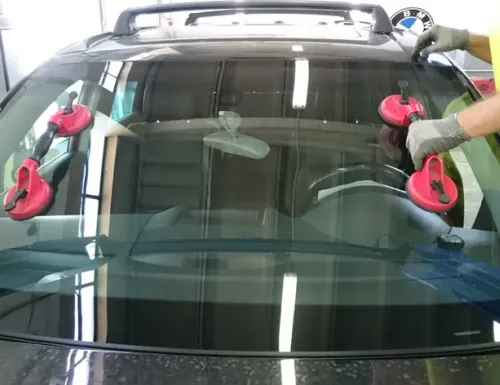
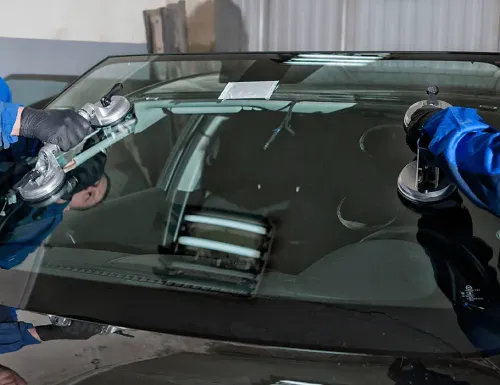
“We can do a replacement in 20 minutes.” A proper windshield replacement takes 60 to 90 minutes of active work. That is the time required to remove the old glass without damaging the pinch weld, clean and prime the channel, apply urethane adhesive correctly, set the glass accurately, allow it to settle, and run a quality check. A 20-minute claim means steps are being omitted.
No mention of ADAS calibration for obvious ADAS vehicles. If you describe your vehicle as a 2022 Toyota RAV4 and the shop does not ask about driver-assist cameras, they are either planning to skip calibration or bill it afterward.
Cash-only pricing. Cash-only shops avoid the paper trail that makes warranty claims traceable. If you have a problem six months after a cash-only installation, your ability to pursue warranty service is limited.
No physical location. Mobile-only operators can do good work, but a permanent physical address provides accountability for warranty claims. A shop that only exists as a phone number and a van has less at stake per individual job.
A quote substantially lower than the market average for your specific vehicle. Lower is not always better. Ask what grade of glass, whether ADAS calibration is included, and whether the price covers all materials. A $199 quote for a 2021 Honda CR-V with a forward-facing camera that does not include calibration is not a savings — it is an incomplete job.
What a Good Shop Looks Like in Practice
A complete, straightforward experience with a reputable auto glass shop looks like this: you call, describe the damage, and receive an all-inclusive quote within five minutes that covers everything. The shop confirms same-day or next-day availability, shows up within the committed window, protects your vehicle’s interior before starting, does the work without rushing, runs a quality check before returning the keys, and explains the aftercare requirements clearly. If anything needs warranty attention afterward, you can reach someone and they fix it.
Midtown Glass Atlanta at 510 Glen Iris Dr NE has operated this way since 1956. Our AGSC certification is current. Our quotes are all-inclusive. We handle ADAS calibration in-house. Our workmanship warranty covers leaks, wind noise, and adhesive failure. We are locally owned, not a franchise, and our reputation in Atlanta’s auto glass market is the thing we protect most carefully.
Family-owned and AGSC-certified, operating from the same location for nearly 70 years.
Call (404) 873-6991 or schedule online for a free quote.
Explore our full auto glass services or check service area coverage.