Every day at our Midtown shop on Glen Iris Drive, someone walks in asking the same question: can this be repaired, or does it need replacement? The answer depends on factors most drivers have not thought through: the type of glass, the size and location of the damage, how old the break is, and whether a camera sits behind the windshield.
This guide gives you the decision framework we use, plus a detailed look at how both processes work. Whether you have a quarter-inch chip from a gravel truck on I-285 or a shattered door window from a parking deck break-in in Buckhead, this page tells you what to expect.
Glass Type Decides Your Options First
Not all auto glass is the same material, and that matters before anything else.
Laminated glass is used for windshields. It consists of two glass sheets with a polyvinyl butyral (PVB) film sandwiched between them. When a rock hits a laminated windshield, the outer glass layer absorbs the impact and may chip or crack, but the PVB interlayer holds everything together. This construction is why chips and cracks in windshields can sometimes be filled with resin and repaired without replacing the entire pane.
Tempered glass is used for side windows, rear quarter panels, and back windows. It is heat-treated to create internal stress that causes it to shatter into small, blunt pieces rather than sharp shards. Because tempered glass breaks into hundreds of fragments, there is no repair for tempered damage. Any break in a tempered panel means the full pane must come out and a new one goes in.
When Repair Is the Right Call
For windshield damage, these factors determine whether resin repair will hold:
Size. A chip smaller than a quarter and a crack shorter than six inches are candidates for repair. Once a crack exceeds six inches, resin fill cannot reliably handle the stress.
Location. Damage at the windshield edge is almost always disqualifying. Edge cracks start within two inches of the border and grow rapidly because the border zone has the highest structural stress. Damage in the driver’s direct line of sight is also typically replaced rather than repaired, because even a good resin fill leaves a slight optical distortion.
Age and contamination. A chip that sat untreated through several of Atlanta’s summer days may have moisture, dirt, or pollen packed into the break. Contaminated breaks often cannot be filled cleanly. This is the single biggest reason to act within a day or two of noticing the damage.
Depth. A chip that penetrated both layers of the laminated glass, which you can feel as a rough edge on the inner surface, almost always requires replacement.
When all criteria are met, repair is the better choice every time. It is faster, cheaper, and skips the full removal and reinstallation involved in a replacement.
How Chip and Crack Repair Works
The repair process is more technical than it looks:
1. Cleaning. The technician uses a small pick to clear any glass fragments or debris from inside the break, then blows the cavity clean and dry.
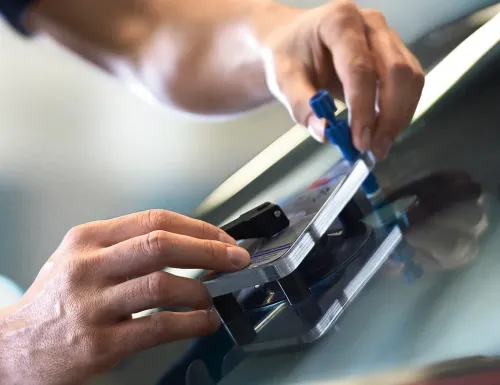
2. Bridge setup. A spring-loaded resin bridge and injector clamp over the chip, with a rubber gasket forming an airtight seal over the break area.
3. Vacuum cycle. The injector pulls negative pressure inside the break, drawing out any trapped air. This cycle may run two or three times. It is the step that most DIY kits skip, and skipping it is what produces the air bubbles that make home-kit repairs look cloudy.
4. Resin injection. Professional optical resin flows into the break under the slight pressure differential. The resin fills every cavity in a bullseye, star break, or combination chip. For a crack, the technician may run a few vacuum-pressure cycles to work the resin along the full length.
5. UV curing. A handheld ultraviolet lamp cures the resin in 45 to 90 seconds. Optical resins are formulated to match the refractive index of the glass, which is why a well-done repair nearly disappears visually.
6. Surface polish. The surface is polished flush with the surrounding glass.
Properly done, a chip repair restores about 85 to 95 percent of original clarity and returns the glass to full structural integrity. You drive immediately after. Total time: 20 to 30 minutes for most chips, 30 to 45 minutes for short cracks.
Cost: $50 to $100. Most comprehensive insurance policies cover chip repairs with no deductible.
How Windshield Replacement Works
When repair is not possible, full replacement follows this sequence at Midtown Glass Atlanta:
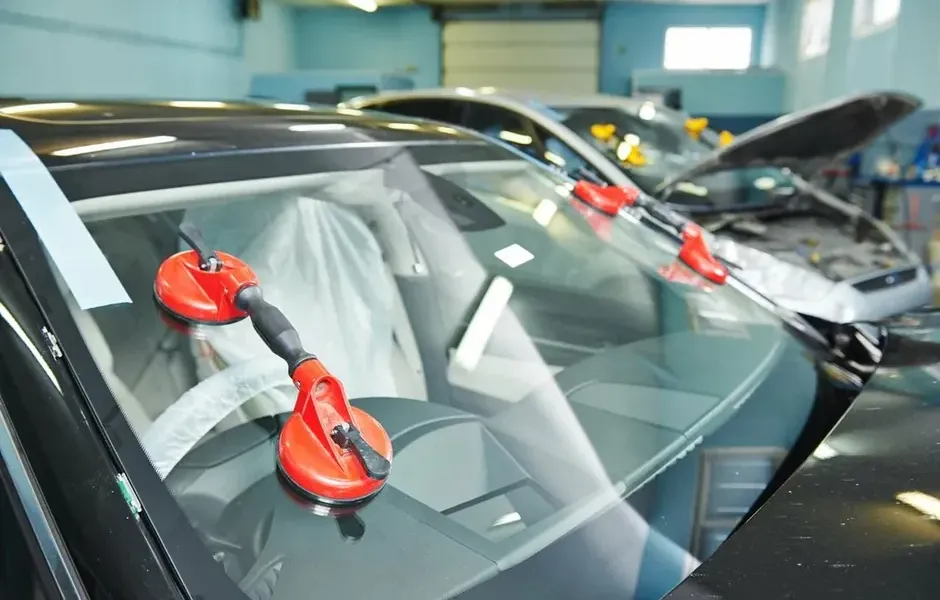
1. Old glass removal. A cold knife or oscillating tool cuts through the urethane adhesive holding the windshield in place. The old glass lifts out carefully to protect the paint and the pinch weld underneath.
2. Surface prep. The pinch weld is cleaned of old adhesive, then primed. Any contamination on the pinch weld creates a weak bond, which leads to leaks and reduced structural contribution in a crash. This prep step is where shortcuts lead to trouble.
3. Glass selection. The replacement windshield must match your vehicle exactly: make, model, year, trim, and any embedded features. Rain sensors, lane departure cameras, heating elements, antenna connectors, and heads-up display coatings all require the correct part. Using the wrong glass is not just a fitment problem; it affects sensor accuracy and your safety systems.
4. Urethane application. A bead of high-modulus urethane adhesive goes around the pinch weld perimeter. This adhesive is both the bond and a structural element. It contributes to roof support in a rollover and forms the backstop that allows the passenger airbag to inflate correctly.
5. Setting and alignment. The new glass is set into the opening, aligned precisely, and all trim and clips reinstalled.
6. Safe Drive Away Time (SDAT). The urethane needs time to cure before the car is safe to drive. Depending on the product and ambient temperature, that ranges from one to two hours with modern fast-cure urethane. Drive too soon and the glass can shift in a hard stop.
7. ADAS calibration. Vehicles made after approximately 2015 with forward-facing cameras (lane departure warning, adaptive cruise, automatic emergency braking) need the camera recalibrated after glass replacement. The camera’s calibration reference is the windshield itself, and any difference in glass position shifts its field of view. We perform static ADAS calibration in-house using calibration targets and a scan tool connected to the vehicle’s OBD port.
8. Water test. Once cured, we run a controlled water flow over the seal before returning the car.
Active work time: 60 to 90 minutes. Plus one to two hours cure time before driving.
Side Window and Rear Glass Replacement
Tempered side and rear windows use a simpler installation. There is no adhesive bond; the glass rides in a channel held by regulator clips. After clearing all shattered glass from the opening, the door cavity, and the weatherstripping channels, the new pane sets into the channel and attaches to the regulator. For rear glass with a defroster grid, we test the electrical connections and defroster function after installation.
Time: 45 to 90 minutes for side windows, 60 to 120 minutes for rear glass.
Why Waiting Costs More
The math here is straightforward:
- Chip repair: $50 to $75, often free through insurance
- Short crack repair: $75 to $100
- Full replacement: $200 to $600 for most passenger vehicles; $500 to $1,200 for vehicles with heads-up displays, acoustic laminate glass, or multiple ADAS sensors
Atlanta’s summer heat is a crack accelerator. A south-facing parked windshield can hit 155 degrees Fahrenheit on the glass surface. Start the car, blast the AC, and the temperature differential at the chip point is significant. We see chips that were repairable Monday turn into foot-long cracks by Wednesday during peak summer.
Georgia O.C.G.A. Section 40-8-73 requires an unobstructed windshield view. A citation starts around $150. The citation goes away once the glass is fixed, but there is no reason to let it get to that point.
After Your Service
For repairs: drive immediately. No restrictions.
For replacements: wait the SDAT your technician specifies, keep the car under cover if possible, leave retention tape on the inside for 24 hours, skip the car wash for 24 hours, and avoid slamming doors for the first few hours since the pressure spike can stress a fresh urethane bond.
Schedule at Midtown Glass Atlanta
Our shop is at 510 Glen Iris Dr NE, Atlanta GA 30308, operating continuously since 1956 as Glass Inc. AGSC-certified technicians, a reputation built over 70 years of Atlanta service, and mobile service that covers the full metro area.
Call (404) 873-6991 or request a quote online.
Explore our windshield replacement services and windshield repair services.