Audi builds its driver assistance systems around a forward-facing camera and radar sensor cluster mounted at the top of the windshield, tucked against the rearview mirror bracket. That camera runs Audi Pre Sense front, active lane assist, traffic sign recognition, and adaptive cruise simultaneously. Pull the windshield and every one of those features goes offline. They stay offline until the camera is re-aimed against a static calibration target and, on many models, followed by a dynamic calibration pass at highway speed.
That sequence is not optional. An Audi that leaves a shop after windshield replacement with an uncalibrated Pre Sense camera may show no warning lights yet still have lane assist pulling incorrectly or forward collision warnings triggering late. Audi’s ADAS tolerances are tight, and the camera angle is measured in fractions of a degree. Buckhead and Sandy Springs Audi drivers increasingly bring their cars directly to Midtown Glass Atlanta at 510 Glen Iris Dr NE for exactly this reason: the glass and the calibration happen in the same appointment, on the same day.
What makes Audi windshields different from ordinary auto glass
Audis sold in the U.S. use acoustic laminated glass as standard equipment on most A, Q, and e-tron models. The acoustic interlayer (a PVB film with sound-attenuating properties) sits between the two glass plies and significantly reduces wind and road noise entering the cabin. Budget aftermarket glass typically omits this layer entirely. The difference is audible at highway speeds, and installing the wrong glass makes the cabin noisier permanently.
There is also the matter of optical clarity in the camera zone. The camera aperture at the top of the windshield is roughly a 200mm x 150mm rectangle through which the Pre Sense system sees the road ahead. The glass in that zone must meet tight optical quality standards for the camera’s exposure and focus to work correctly. Inferior glass can cause subtle distortions that produce calibration failures or reduced ADAS performance. This is why we use OEM-quality glass for Audi replacements rather than generic aftermarket units, and why we recommend true OEM glass for models where the dealer supply chain can deliver it within a reasonable timeframe.
Some Audi models, including the Q7, A6, A8, Q8, and e-tron SUVs, offer a heads-up display. The HUD projects speed and navigation data onto the lower windshield using a specific wedge angle built into the glass. If the replacement windshield lacks the correct wedge profile or anti-reflective coating in the HUD zone, the projected image doubles or blurs. This happens when shops substitute non-HUD glass to cut cost, and it is not fixable by adjustment. The glass has to come out and be replaced with the correct piece.
The Atlanta factor
The Downtown Connector runs directly through the heart of the city, and it is one of the worst roads in Georgia for windshield damage. Semi-trucks dropping gravel and debris on I-75/I-85 between the Brookwood Interchange and the University Avenue split accounts for a significant share of the rock chips we see on Q5 and A4 models from Midtown and Virginia-Highland. Add summer hailstorms rolling up from the south and Atlanta’s temperature swings from 50 degrees overnight to 88 degrees by afternoon, and the Audi population takes a beating.
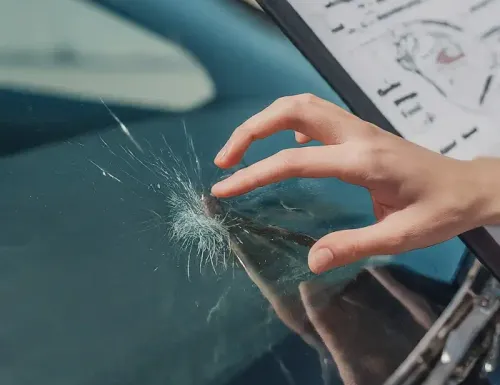
A chip smaller than a dollar coin in the right location can be repaired in about 30 minutes with resin injection. Chips that sit directly in front of the camera zone, in the driver’s swept area, or at the edge of the glass near the sensor strip are generally not candidates for repair. Cracks longer than six inches almost never are. When in doubt, bring the car in and let us assess it before the damage spreads.
Why we prefer in-shop service for Audi replacements
Mobile service works well for many vehicles. For most Audi replacements, though, we prefer work at our 510 Glen Iris Dr NE facility. Proper ADAS calibration requires a flat, controlled surface with precise lighting and a known distance between the calibration target and the vehicle. Parking lots and driveways rarely meet those requirements. Mobile installs can be done safely in certain conditions, but calibration accuracy is harder to guarantee. If your Audi has Pre Sense, lane assist, or adaptive cruise, in-shop service is the more reliable path.
Glass types, calibration, and what to expect
Full Audi windshield replacement runs 90 to 150 minutes in our facility, including the static calibration target procedure. Models requiring a subsequent dynamic calibration pass need additional time and a brief highway drive. We provide all-in pricing before the appointment: glass, adhesive, calibration, and shop time.
A few things worth knowing before you book:
- Rain sensors: Most Audis have an integrated rain sensor bonded to the windshield that must be detached and reattached during replacement. This is standard procedure, not an upsell.
- Camera housing: The Pre Sense camera sits in a bracket that mounts to the glass on many Audi models. We replace the adhesive mounting pad as part of the job.
- Acoustic certification: If your Audi came with acoustic glass from the factory, we install acoustic-rated replacement glass. Ask us to confirm this in the quote.
Our shop has served Atlanta since 1956 under the Glass Inc. name and is AGSC-certified. Reach us at (404) 873-6991 or sales@glassinc.net. You can also use our instant quote tool to pull your vehicle’s exact glass specifications before calling, or get a fast estimate at /instant-quote/.
When repairs are possible, and when they are not
Small chips (under one inch) that fall outside the critical camera zone and outside the driver’s primary line of sight can usually be filled with optical resin under vacuum. The repair takes about 25 minutes, eliminates the spreading risk, and the resin is UV-cured to near-glass hardness. You will likely still see a faint mark, but the crack stops there.
Cracks longer than three inches, chips in the camera zone, damage at the edge of the glass, or any crack that has penetrated both layers of the laminate all require full replacement. We will tell you which category you are in after inspection, not after we have already started pulling the old glass.
Coverage and costs
Audi windshield replacement with calibration typically runs $450 to $900 in Atlanta depending on model, year, whether HUD glass is involved, and whether dynamic calibration is required in addition to static. Comprehensive insurance almost always covers windshield work. We handle claims directly with your insurer.
For pricing specific to your A4, A6, Q5, Q7, or any other Audi variant, call (404) 873-6991 or visit /instant-quote/.
Frequently asked questions
Do all Audis need ADAS calibration after windshield replacement?
Any Audi built after roughly 2015 that has lane assist, adaptive cruise, or Audi Pre Sense requires camera recalibration after the windshield is replaced. Older models without those systems do not. If you are unsure whether your car is equipped, look for an adaptive cruise stalk on the steering column or check the instrument cluster for a lane assist icon. We can confirm during the initial inspection.
Is OEM Audi glass worth the extra cost?
For models with HUD or complex camera optics, yes, it is generally worth it. For older A4 or Q3 models without those features, high-quality OEM-equivalent glass performs identically in practice. We will tell you which option applies to your specific car and order accordingly.
Can I drive my Audi immediately after windshield replacement?
Normal city driving is safe about 60 minutes after installation, once the urethane adhesive achieves minimum drive-away strength. We use moisture-curing urethane that reaches safe drive-away strength quickly. We give you the exact drive-away time with your completed service paperwork.
Do you handle the rain sensor during replacement?
Yes. The rain sensor is detached from the old glass and transferred to the new windshield as a standard part of the replacement procedure. No separate charge applies.
How do I know if my chip is in the camera zone?
On most Audis, the camera sits behind a black rectangular band at the very top center of the windshield, typically within 6 inches of the upper edge. If your chip is anywhere near that area, call us before assuming it is repairable. A chip that looks manageable may be too close to the sensor optics for a reliable repair.
Learn more about our windshield replacement services, ADAS calibration, or windshield repair.