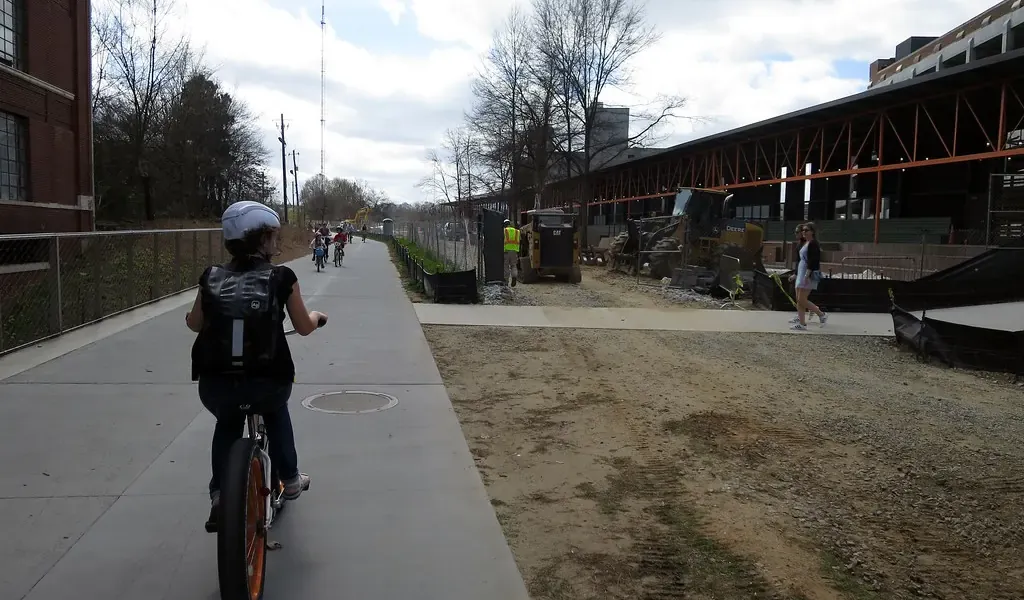
Our shop sits on Glen Iris Drive, which means we watch the Old Fourth Ward’s construction traffic go by all day. Concrete trucks turning off North Avenue. Dump beds coming out of sites along Boulevard with a film of aggregate still on the tires. Flatbeds heading for whatever is going up next along the Eastside Trail corridor. All of it leaves small stone on the pavement, and small stone is what puts chips in windshields.
This is a neighborhood-specific problem, and it shows up in what comes through our door.
Why O4W chips more than the suburbs do
Three things stack here. Construction vehicles track aggregate out of sites and onto public streets, so the loose material is not confined to the work zone. The street grid is short and stop-heavy, which means constant acceleration from a standstill, and a tire spinning up from rest flings a stone harder than one cruising. And the neighborhood still has surface lots with gravel or broken asphalt, the kind behind older buildings on Edgewood and Auburn, where every car that pulls out throws a little of the lot at whatever is behind it.
Add the Ponce City Market deck and the tight ramp turns around it, where cars queue nose to tail, and you get the classic pattern: a chip low on the passenger side, taken at low speed, from a car three feet ahead.
The anatomy of the thing that just hit your glass
A windshield is laminated. Two plies of glass bonded to a plastic interlayer, which is why it holds together instead of raining into your lap. A stone strike normally cracks only the outer ply and pushes a small cone of glass out of it, leaving a void.
What that void looks like determines everything that follows:
- Bullseye. A clean circular separation with a dark ring. The most repairable shape there is.
- Half-moon. The same thing, partial. Usually repairable.
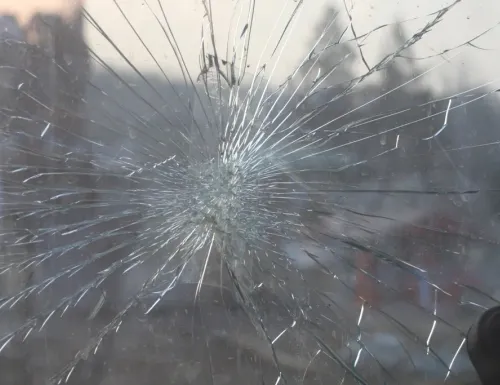
- Star break. A central pit with legs radiating out. Repairable when the legs are short, and the legs are what run.
- Combination break. A bullseye with legs. Judged on the legs.
- Surface pit. Material knocked off the outside without penetrating. No void to fill, so nothing to repair, though it can catch light.
If the strike went through to the inner ply, or you can feel it from inside the car, it is not a repair.
| Damage | Usually repairable? | What decides it |
|---|---|---|
| Bullseye | Yes, up to about quarter size | Location, not shape |
| Half-moon | Usually | Same rules as a bullseye |
| Star break | When the legs are short | Leg length, not overall width |
| Combination break | Judged on the legs | Whether the legs have started to run |
| Surface pit | Nothing to fill | Only cosmetic, catches light |
| Any damage within 2 inches of the edge, in the driver’s view, or in the camera’s view | No, replace | Stress at the edge, distortion, camera accuracy |
Where the line actually falls
Size gets quoted loosely everywhere, so here is how we call it. A bullseye or combination break up to roughly the diameter of a quarter is normally a repair. Star breaks depend on leg length rather than overall width. A crack is a different question and is usually about length and where it starts.
The disqualifiers matter more than the size:
Edge damage. Anything within about two inches of the perimeter sits in the most highly stressed part of the glass and the most structurally important part of the bond. Edge cracks run. We replace them.
The driver’s primary viewing area. Repair resin restores strength, but it leaves a visible mark. The industry repair standard maintained by the Auto Glass Safety Council, ROLAGS, exists precisely to keep shops from putting optical distortion in front of the driver’s eyes to save a few dollars.
The camera’s field of view. Cars carrying a forward-facing camera at the top of the glass get a replacement for damage in the area that camera looks through, even when the shape would otherwise repair fine. The camera reads lane lines and vehicle outlines through that glass. A repaired star break in its path is not something you calibrate around.
Age and contamination. A chip that has sat for six weeks has road film, wax and water bonded into the void. Resin displaces air. It does not displace what has already set up in there, and the finished repair looks and holds worse.
Atlanta heat and storms are what make a chip run
The mechanism is thermal, not mechanical. A car parked on the top deck at Ponce City Market in July reaches an interior temperature well above ambient, and the glass with it. Then an afternoon thunderstorm drops cold rain on the outer surface. The two plies and the interlayer expand and contract at different rates, and the stress finds the weakest point, which is the tip of a star break leg.
Defrost does the same thing in reverse in January. Hot air on the inside of cold glass has ended more chips than gravel ever did. If you have fresh damage, warm the car gradually and keep the vents off the crack.
Time and cost, plainly
A chip repair takes about half an hour and starts at $49 on our price list. The resin goes in under vacuum and then pressure, cures under a UV lamp, and gets scraped and polished flush. It restores the strength of the outer ply and stops the break from spreading. It does not make the mark disappear, and any shop that promises otherwise is overselling.
Replacement starts at $199. Add calibration at $150 to $400 if the vehicle has a camera behind the glass. That gap is the whole argument for handling a chip in the week it happens rather than the month.
Coming to us
The shop is at 510 Glen Iris Dr NE, open Monday through Friday, 8am to 5pm, close enough to Ponce de Leon Avenue that most of the Old Fourth Ward is a five-minute drive. Inman Park and Poncey-Highland are barely further.
Photograph the damage with something for scale, a coin works, and send it through the quote form or call (404) 873-6991. We will tell you which of the shapes above you are looking at before you drive anywhere. If the chip has already run into a crack, our timeline guide explains what a replacement takes and when the part has to be ordered.
Common questions
How big a windshield chip can be repaired?
A bullseye or combination break up to roughly the diameter of a quarter is normally a repair, and star breaks are judged by how long the legs are. Location matters more than size: damage within about two inches of the edge, in the driver's direct view, or in the camera's field of view gets a replacement instead.
Why did my windshield chip turn into a crack after a storm?
Heat, not the stone. Glass that bakes on a top parking deck and then takes cold afternoon rain expands and contracts unevenly, and the stress runs to the tip of a star break leg. Defrosting a frozen windshield does the same thing in winter. If you have fresh damage, warm the car gradually and keep the vents off the crack.
Will a chip repair make the damage invisible?
No. The resin goes in under vacuum and pressure, cures under a UV lamp and is polished flush, which restores the strength of the outer layer and stops the break from spreading. A faint mark always remains. Expect about half an hour in the chair, starting at $49, against $199 or more for a replacement.
Is it too late to repair a chip I got a month ago?
Often it still repairs, but not as well. After a few weeks, road film, wax and water bond into the void, and resin only displaces air, not what has already set in there. The finished repair looks and holds worse. That is the argument for getting a fresh chip done in the week it happens.