Short answer: Georgia does not outlaw every crack in a windshield. The rule most people are looking for is one sentence in the Official Code of Georgia, O.C.G.A. 40-8-73(e), and it is narrower than the internet suggests. It covers starburst and spider web damage larger than three inches by three inches, on the windshield or the rear window. A couple of neighbouring subsections and one general equipment statute fill in the rest.
Plenty of pages online cite the wrong section, quote rules that are not in the text, or both. So here is the wording itself, followed by what it means when you are standing in a parking deck looking at your glass.
This is a plain reading of the statute for drivers, not legal advice.
The exact wording, section by section
Everything below is quoted from the Georgia Code.
40-8-73(e), the size rule. “No motor vehicle shall be operated with a windshield or rear window having a starburst or spider webbing effect greater than three inches by three inches.”
40-8-73(a), obstructions. This one bars signs, posters or any other nontransparent material on the windshield, side windows or rear windows when it blocks the driver’s clear view of the road or a crossing road. The subsection goes on to list exceptions for things like required stickers and permitted tint.
40-8-73(b) and (c), wipers. Every windshield needs a driver-operated device for clearing rain and snow, and “every windshield wiper upon a motor vehicle shall be maintained in good working order.”
40-8-73(d), no stand-ins for glass. “No opaque or solid material including, but not limited to, cardboard, plastic, and taped glass shall be employed in lieu of a glass windshield or window.”
40-8-78, safety glazing. This is the other windshield section, and the one that gets misquoted. It says anyone “engaged in the business of replacing windshields or any side or rear windows” has to use safety glazing material, meaning glass made to reduce injury when it cracks or breaks. It governs the glass a shop puts in. It has nothing to say about how big a crack you may drive with.
40-8-7, the enforcement hook. Nobody may drive a vehicle unless its equipment is “in good working order and adjustment” and the car is not in a condition that endangers people. Driving an unsafe or improperly equipped vehicle is a misdemeanor.
| Code section | What it covers | What it means for your car |
|---|---|---|
| 40-8-73(e) | Starburst or spider web damage over 3 in. by 3 in. on the windshield or rear window | A spreading break bigger than a 3 inch square is over the line |
| 40-8-73(a) | Signs, posters or other nontransparent material that block the driver’s clear view | Anything opaque stuck in your line of sight is a problem at any size |
| 40-8-73(b), (c) | A working wiper system | Torn blades or a dead wiper motor count too |
| 40-8-73(d) | Cardboard, plastic or taped glass used in place of glass | A taped-up smashed window is a stopgap, not a fix |
| 40-8-78 | Safety glazing for replacement windshields and windows | Whoever replaces your glass must install safety glass |
| 40-8-7 | Unsafe or improperly equipped vehicles | Gives an officer a general basis to cite, as a misdemeanor |
What “three inches by three inches” looks like on real glass
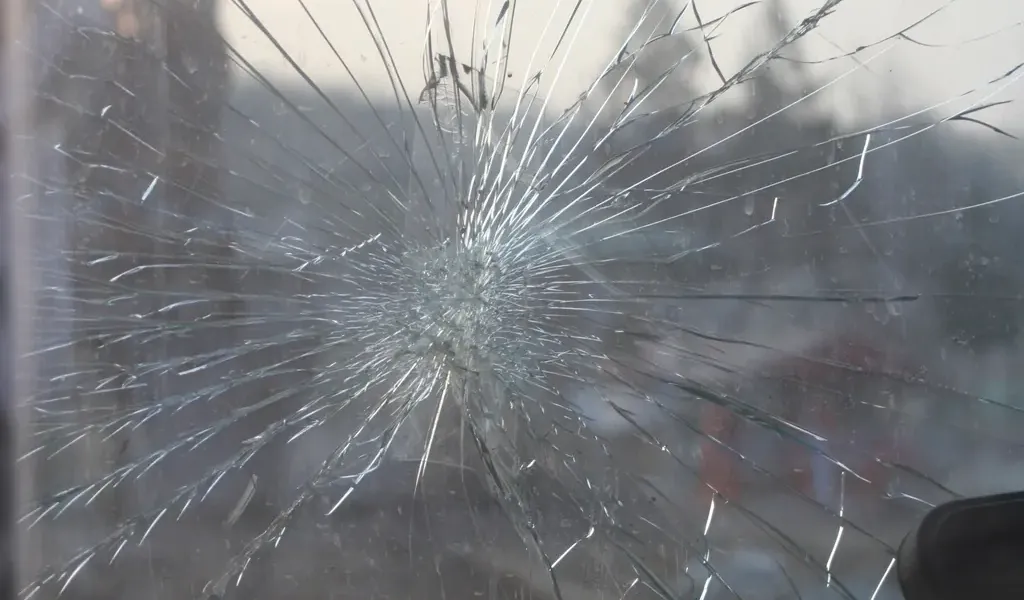
A starburst or spider web is the damage pattern that radiates outward from an impact point: legs of cracks running off in several directions, sometimes with a crushed center. The statute measures the effect, not the pit where the rock hit. So picture the smallest square box that would contain every leg. If that box is bigger than three inches on a side, the text describes your windshield.
For scale, a standard bank card is a little over three and three eighths inches long. Hold one against the glass from the inside. If the legs reach past both ends of the card, you are close to or over the line.
Two things the statute does not say, despite what gets repeated online. It does not set a length for a single straight crack, and its text does not create a separate rule about damage within a set distance of the driver’s line of sight. A long line crack is not automatically fine, though. The general equipment rule in 40-8-7 still applies to glass that is not in safe working order, and on the practical side a crack that keeps running is usually past saving with resin anyway.
The rear window counts, the side windows work differently
Subsection (e) names the windshield and the rear window. Rear glass on most cars is tempered, and tempered glass rarely sits there with a neat spider web. It tends to crumble into small cubes all at once, which is why a hit back window is normally a gap rather than a crack.
Side windows are where subsection (d) shows up. After a smash-and-grab, the usual move is a trash bag and packing tape over the opening. That keeps the rain out while the car is parked. The code, though, says plastic and taped glass may not be employed in lieu of a glass window. Treat the cover as a way to get through the night, and read what to do in the first hour after a break-in before you start pulling glass out of the door.
Why 40-8-78 matters when you pick a shop
Because 40-8-78 is about the replacement, it is the section that applies to us rather than to you. Windshields are laminated safety glass and door glass is usually tempered safety glass. A shop replacing either one has to install safety glazing, full stop.
That floor says nothing about how the glass is bonded in, which is where install quality lives. We set windshields to the AGSC/AGRSS bonding standard and hold the car until the urethane reaches safe drive-away strength, typically one to four hours depending on the adhesive, the temperature and the humidity.
Check your windshield in five minutes
- Measure the pattern, not the impact point. Use a ruler or the bank card trick above.
- Note the shape. A bullseye or small star is a different conversation from a spider web or a single line crack.
- Find where it sits. Within about two inches of the edge, in front of the driver, or in front of a camera behind the mirror all push toward replacement.
- Take a photo with a coin next to it for scale. That photo is most of what we need to tell you repair or replace before you drive over.
- Check the wipers while you are there. A blade that streaks is dragging grit over the glass, and that grit is what leaves the pitting you see under headlights.
Repair or replace, with the law in mind
The legal line and the repair line are not the same line, and the repair line comes first.
A bullseye, star or combination break up to roughly the size of a quarter, clear of the edge and out of the driver’s view, is normally a resin repair. That is $49 and about thirty minutes, nowhere near three inches by three inches, and it stops the break from spreading into something that is.
Once a spider web has grown past the three inch box, it is past repair as well. That job is a windshield replacement from $199, plus $150 to $400 for forward camera calibration on cars that need it. Both figures sit on our posted price list.
Driving for a rideshare platform adds a second set of rules on top of the statute. The platforms run their own vehicle inspections, which we cover in getting a windshield inspection-ready. Students watching every dollar will get more out of the cheapest honest path through a chip or crack.
Getting it looked at
You will find us at 510 Glen Iris Dr NE in Old Fourth Ward, Monday to Friday, 8am to 5pm. Walk a chip in, or call (404) 873-6991 with the photo and your year, make and model. Claims go straight to State Farm, GEICO, Progressive, Allstate, Liberty Mutual or USAA, and we read your policy before we touch the car so you know what you owe.
Common questions
Is a cracked windshield against the law in Georgia?
Not every crack. O.C.G.A. 40-8-73(e) bars operating a vehicle whose windshield or rear window has a starburst or spider webbing effect greater than three inches by three inches. Subsection (a) separately bars nontransparent material that blocks the driver's clear view, and 40-8-7 makes driving an unsafe or improperly equipped vehicle a misdemeanor. A small chip is not what the statute describes.
Does the three inch rule apply to a single straight crack?
The statute's wording names a starburst or spider webbing effect, and it does not set a length for a single line crack. That does not make a long crack safe to ignore. It can still obstruct your view, it weakens a structural part of the car, and once it runs to the edge it is a replacement rather than a repair.
Can I tape plastic over a broken car window and keep driving?
Subsection (d) of 40-8-73 says no opaque or solid material, naming cardboard, plastic and taped glass, may be used in place of a glass windshield or window. Plastic sheeting keeps rain out of a parked car for a night. Plan on getting the glass replaced rather than driving around on the cover.
Which Georgia law covers replacement windshield glass?
O.C.G.A. 40-8-78. It requires anyone in the business of replacing windshields or side and rear windows to install safety glazing material, glass built to reduce injury when it cracks or breaks. It is sometimes quoted as the crack rule. It is not. The crack size limit sits in 40-8-73(e).